

Five villages in Central Java produce more than 33,000 tonnes of rice husk and corn cob residues every year. Most of it is burned in open fields or left to decompose, releasing CO2, methane, and nitrous oxide into the atmosphere. Our Rice Husk and Corn Cob Biochar Carbon Project converts that waste into stable, soil-bound carbon, generating 9,805 tCO2e of verified Net Carbon Storage credits annually, alongside a soil amendment that farmers buy back at a discount to improve their yields.
Bioachar Carbon Project at a glance
- Location: Central Java, Indonesia
- Feedstock: Rice husk and corn cob, sourced from local farmers
- Annual feedstock availability: Rice husk 16,728 t/year, corn cob 16,713 t/year
- Carbon credit type: Net Carbon Storage
- Annual removal potential: 9,805 tCO2e/year
- Process: Pyrolysis (BST-06 in Phase 1, BST-50S in Phase 2)
- Model: Community-based, cooperative-led, revenue-shared with farmers
The Harm of Agricultural Residues in Central Java
In rice and corn growing regions, the standard methods for handling crop residues are both environmentally damaging and expensive for the farmers themselves.
The emissions problem
Most agricultural waste is either left to decompose or burned in open fields. Both ways release significant greenhouse gases (CO2, CH4, and N2O), which drive climate change and produce air pollution that hurts community health.
The soil problem
To compensate for soil that is steadily losing structure and nutrients, farmers rely on heavy applications of inorganic fertilizer. That raises their production costs every season and degrades the soil further over time, creating a feedback loop that is expensive to escape.
How We Turn Agricultural Waste Into A Resource
The project’s central idea is that the residues themselves are the solution. We use pyrolysis, a thermochemical process that decomposes biomass (rice husk and corn cob) in a high-temperature, low-oxygen environment. The process delivers two outcomes simultaneously:
- Avoids emissions: The residues are not burned or left to decay, so the greenhouse gases that would have been released stay out of the atmosphere.
- Produces biochar: A stable, carbon-rich solid that locks carbon into the soil for hundreds to thousands of years when applied to fields.
The process also produces bio-oil as a by-product (sold back to farmers via the cooperative) and non-condensable gases (syngas) that are recycled inside the reactor to sustain process heat and minimize the fossil-fuel use of the machine.
Applied to fields, biochar functions as a long-term soil amendment. Pilot site data from Central Java (2024 monitoring) shows the direct impact on farmers:
- 12.5% increase in crop yield
- 15% improvement in water-use efficiency
- 20% reduction in inorganic fertilizer use
Why Biochar Carbon Project Generates High-Quality Carbon Credits
Biochar projects meet four criteria that are increasingly the threshold for high-integrity carbon credits in voluntary and compliance markets.
- Long-term carbon storage: Carbon stored in biochar can remain locked in soil for hundreds to thousands of years, preventing it from returning to the atmosphere.
- Measurable and verifiable impacts: The amount of carbon stored is quantifiable and verifiable under recognized carbon standards, which is why biochar credits are typically priced at a premium relative to short-lived avoidance credits.
- Prevents carbon leakage: Because the project uses agricultural residues that would otherwise be burned or decomposed, it does not shift emissions to another sector or geography.
- Community-based: The project engages local communities directly by purchasing residues from farmers and returning the resulting biochar to them at a discount, so the climate outcome and the livelihood outcome reinforce each other.
Project overview
- Project Location: Central Java, Indonesia.
- Feedstock: Rice husk and corn cob, sourced from local farmers.
- Feedstock Availability: Rice husk 16,728 t/year and corn cob 16,713 t/year)
- Designed Capacity (Phase 1): The BST-06 pyrolysis unit is designed to process 100 kg/hour.
- Carbon Credit: Net Carbon Storage.
- Potential Removal: 9,805 tCO2e/year.
Community-based Workflow
The entire project is structured under a community-based model to ensure traceability, cost-efficiency, and inclusion.
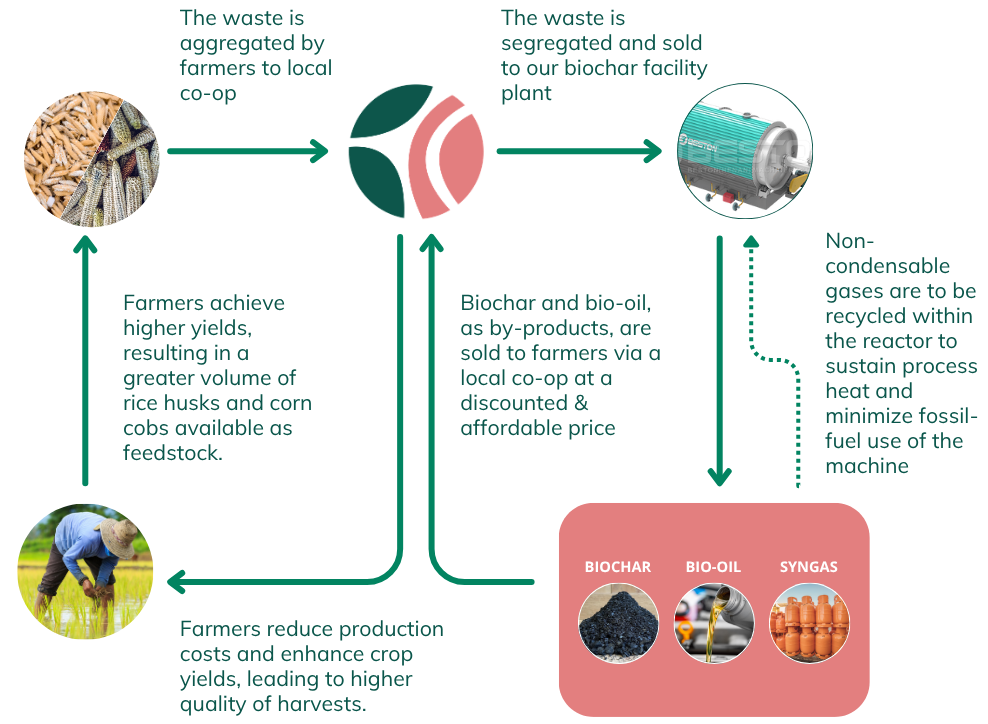
- Supply: Farmers aggregate and sell rice husk and corn cob residues to a local cooperative.
- Processing: The facility converts the residues into biochar and bio-oil via pyrolysis. Non-condensable gases are recycled inside the reactor to sustain process heat.
- Value return: Biochar and bio-oil are sold back to farmers through the cooperative at a discounted price for soil application. Improved yields produce more residues, which become next year’s feedstock.
- Carbon credit: Revenue from the carbon credits generated is shared between the cooperative and TruCarbon.
Join Our Biochar Carbon Project: Invest in Rural Empowerment
We are inviting corporate partners to scale this model through our Corporate Social Responsibility (CSR) program. The funding goes into one of two phases.
Phase 1 (Pilot)
- Construction of the initial biochar production facility (BST-06 unit).
- Community empowerment programs.
- Development of healthcare and sanitation facilities.
Phase 2 (Expansion)
- Procurement and installation of a larger biochar production unit (BST-50S).
- Expansion of healthcare and sanitation facility development.
What CSR partners receive
- A contribution to a project with a verified annual carbon sequestration potential of 9,805 tCO2e.
- A replicable multistakeholder partnership model that can be deployed in other rice and corn growing regions of Indonesia.
- A comprehensive Impact Report covering climate impact, community livelihoods, and financial accountability.
Alignment with Global Goals
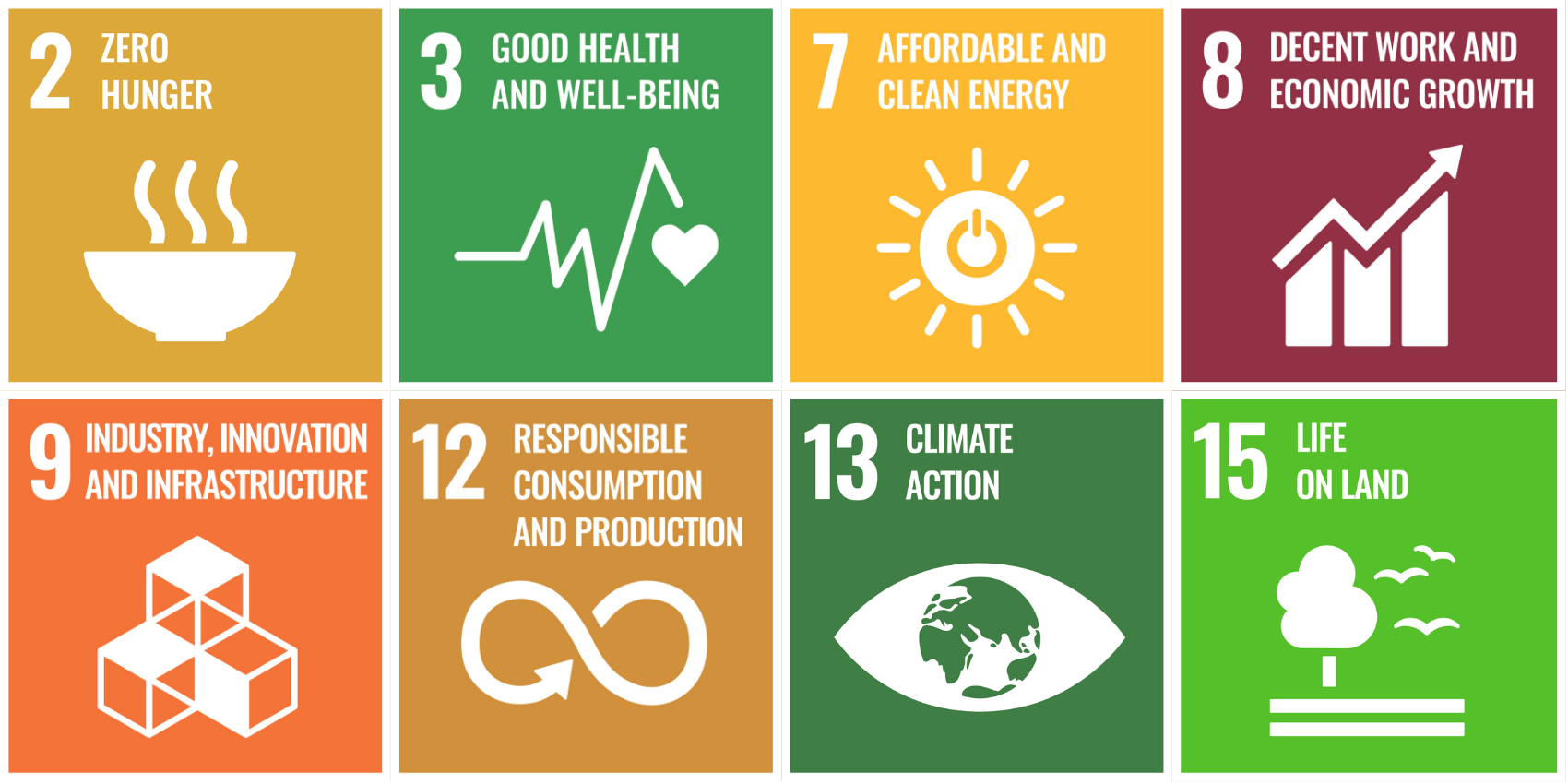
This biochar carbon project is a working model for several Sustainable Development Goals, including climate action, responsible consumption and production, life on land, and decent work and economic growth.
Have agrowaste you’re not fully utilizing? There’s an opportunity to convert it into verified carbon revenue while creating a measurable environmental impact. Or are you interested in developing a biochar carbon project or investing in one? Let’s talk.
Frequently asked questions
- What is biochar?
Biochar is a stable, carbon-rich solid made by heating biomass (in this project, rice husk and corn cob) in a low-oxygen environment. The process is called pyrolysis. When applied to soil, biochar locks carbon away for hundreds to thousands of years and improves nutrient and water retention. - How much CO2 does the Rice Husk and Corn Cob Biochar Carbon Project remove each year?
The project has an annual removal potential of 9,805 tCO2e, issued as Net Carbon Storage credits. - What feedstock does the project use?
Rice husk (16,728 t/year available) and corn cob (16,713 t/year available), sourced directly from local farmers in Central Java rather than industrial mills. - How are farmers compensated through this biochar carbon project?
Farmers are paid for the residues they aggregate to the cooperative, buy back biochar and bio-oil at a discount to improve their soils, and receive a share of the revenue generated by the carbon credits through the cooperative. - What kind of carbon credit does this project generate?
Net Carbon Storage credits. The carbon stored in biochar applied to soil is durable (typically hundreds to thousands of years) and verifiable under recognized carbon standards. - Where is the project located and how can companies participate?
The project is located in Central Java, Indonesia. Companies can participate through TruCarbon’s CSR program, which funds either the Phase 1 pilot facility or the Phase 2 expansion to a larger BST-50S unit. Partners receive a full Impact Report covering climate, community, and financial outcomes. - How does the Biochar Carbon Project avoid creating new emissions?
The pyrolysis reactor is designed to recycle its own non-condensable gases (syngas) internally to sustain process heat, which minimizes the fossil-fuel use of the machine itself.