
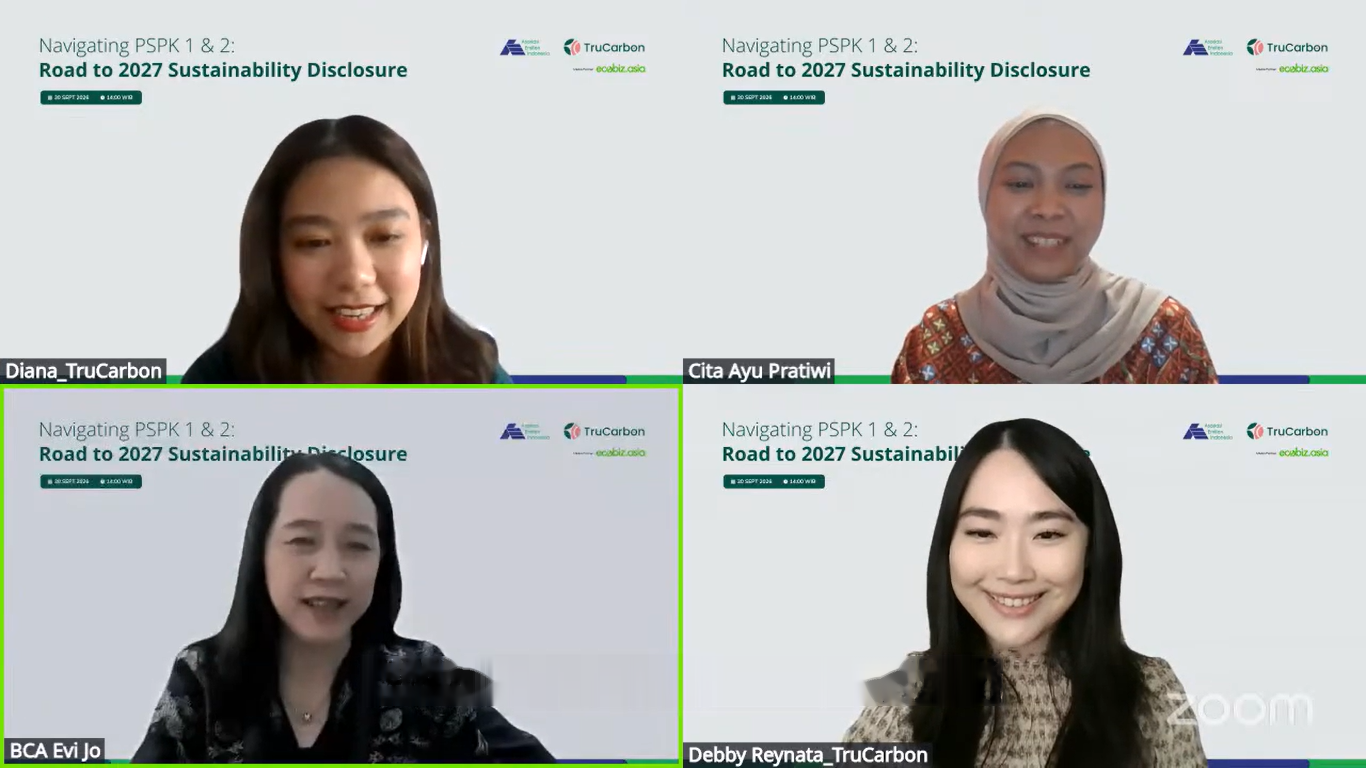
JAKARTA – Indonesia’s listed companies have roughly three months to get their sustainability data and disclosure processes ready before Sustainability Disclosure Standards (PSPK) 1 and 2 take effect for annual reporting periods beginning Jan. 1, 2027. The standards come from the Sustainability Standards Board of the Institute of Indonesia Chartered Accountants (DSK IAI). They require sustainability data that can be traced back to source documents and linked to the financial statements, so companies should start building their data collection systems now. That was the central message of “Navigating PSPK 1 & 2: Road to 2027 Sustainability Disclosure,” an online seminar TruCarbon and the Indonesian Issuers Association (AEI) held on September 30.
AEI Executive Director Gilman Pradana Nugraha said getting data ready is the main job facing listed companies. “Sustainability disclosure is moving closer to financial reporting and investor decision-making. We need to make sure data is complete and intact, governance is clear, ownership within the company is clear, data collection processes are valid and reliable, and the sustainability team is connected to the other teams,” he said.
More Than a New Report Format
The obligation to publish a sustainability report is not new. Since 2019, the Financial Services Authority (OJK) has required listed companies, financial services institutions, and public companies to publish one under OJK Regulation (POJK) No. 51/2017. What has changed is the technical standard behind the report. DSK IAI ratified PSPK 1 and 2 on July 1, 2025. They adopted IFRS S1 and IFRS S2 from the International Sustainability Standards Board (ISSB).
Cita Ayu Pratiwi, a member of IAI’s Sustainability Working Team, said PSPK 1 is the general “umbrella” framework that sets out what sustainability reporting requires. PSPK 2 covers climate-specific disclosures. Both share the same four core content areas: governance, strategy, risk management, and metrics and targets. The standards will keep expanding through PSPK 3, 4 and 5 to cover sustainability-related risks and opportunities beyond climate.
She added that PSPK is designed to serve investors and to produce information that can be compared globally. Its primary users are existing and potential investors, lenders and other creditors. They use the information to decide whether to buy, sell or hold shares and debt securities, and whether to extend loans.
According to Cita, PSPK looks at sustainability reporting from a different angle. “Previously, the perspective may have been how a company affects the outside world, whether on environmental, social or governance matters. This time, we’re shifting the view slightly to look at how those aspects affect the company internally,” she said.
To get started, Cita advised companies not to begin by asking what they must disclose. Instead, they should assess whether their current processes are good enough to support effective sustainability disclosure and implementation.
A Cross-Divisional Effort
Speaking for listed companies, Evi Jo, Head of the Sustainability & CSR Subdivision at PT Bank Central Asia Tbk (BCA), explained how the bank brings its teams together to prepare its sustainability report. Evi said implementing PSPK requires collaboration across divisions, particularly the sustainability, risk, business and accounting teams.
For BCA, the sustainability report is about accountability, not about looking good through polished writing. The report shows how BCA delivers on its sustainability commitments. It is also how the bank, as a listed company, meets its responsibility to investors.
A 90-Day Plan Ahead of Fiscal Year 2027
TruCarbon Director Debby Reynata called the final 90 days of 2026 a critical window to prepare for fiscal year 2027 under PSPK 1 and 2. She recommended three phases. In the first phase, days 1 to 30, companies set the scope of reporting entities to match the consolidation boundary of their financial statements and set up governance for it. In the second phase, days 31 to 60, they build a “data engine”: a map of activity data at every site that records its source, unit, frequency, and owner.
The third phase, days 61 to 90, is a test run. “We recommend doing a dry run with the previous year’s data,” Debby said. The test lets companies find data gaps early, before they show up during assurance. “These 90 days are enough to make sure fiscal year 2027 starts with a system or SOP that’s already running,” she said.
She also pointed to the three-year disclosure relief for Scope 3 emissions, the indirect emissions from a company’s value chain. That is longer than the one year IFRS allows. But the relief only delays disclosure, not data collection. Companies still need to start collecting Scope 3 data regularly now. Its quality improves only over several reporting cycles, and it depends on supplier involvement.
To ease that preparation, TruCarbon developed TruCount, carbon accounting software that simplifies the entire sustainability disclosure process, from collecting emissions data to compiling reports. As part of its support for listed companies, the company is giving seminar participants 90 days of free premium access to TruCount.