
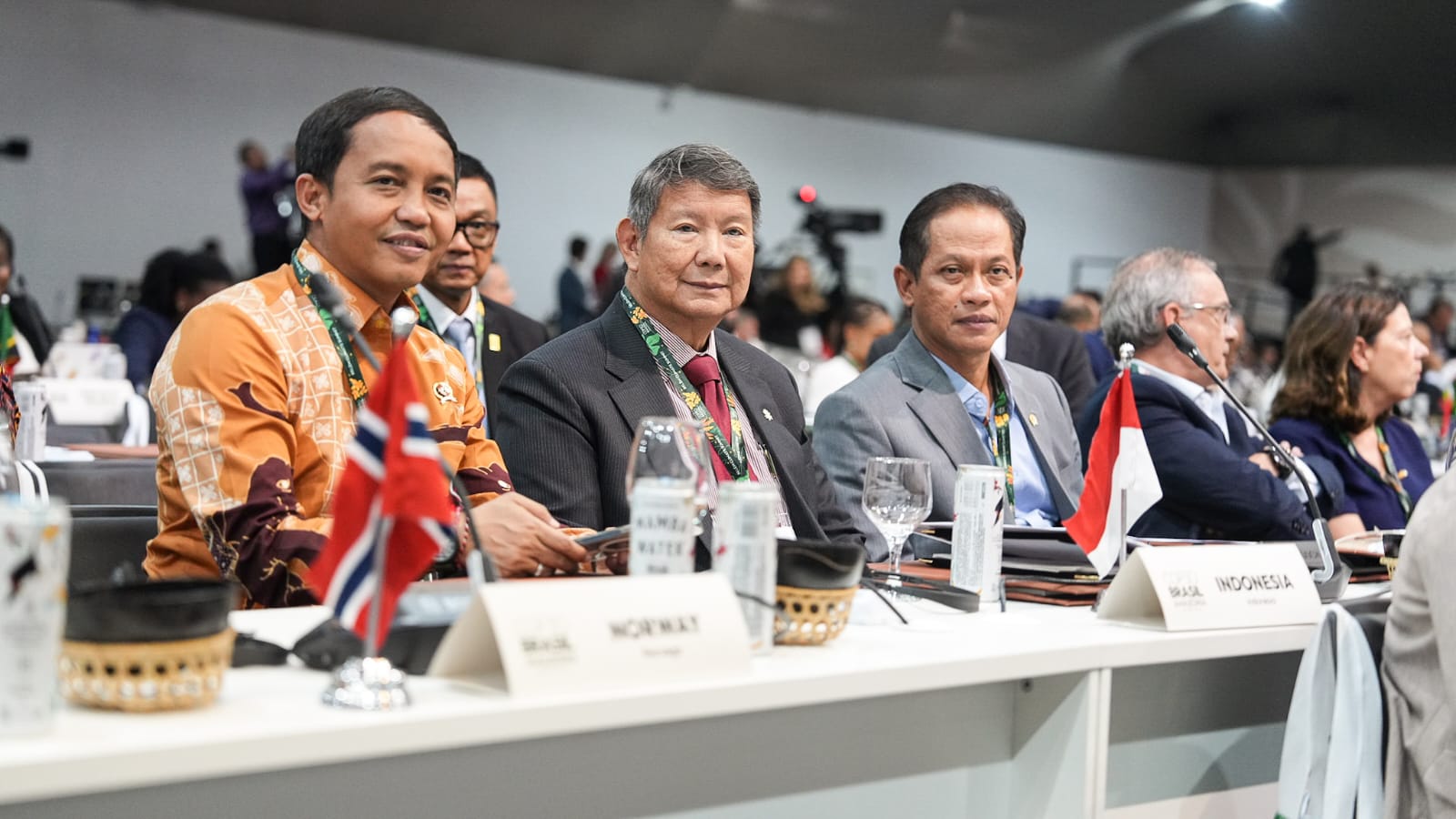
Ahead of COP 30 in Brazil, the Indonesian government submitted its Second Nationally Determined Contribution (SNDC) to the UNFCCC in October 2025. This Second NDC marks a new chapter in Indonesia’s emission reduction targets and efforts, replacing the Enhanced Nationally Determined Contribution (ENDC). The Second NDC specifically focuses on emission reduction targets for the 2031–2035 period, while the ENDC covered the 2026–2030 period.
To achieve the ambitious goals set out in the Second NDC, Indonesia is focused on scaling up climate finance, particularly through the carbon market. The Second NDC emphasizes the enforcement of Presidential Regulation (Perpres) No. 110 of 2025, concerning the Implementation of the Carbon Pricing Instrument and National Greenhouse Gas Emission Control, which was only signed on October 10, 2025. This regulation serves as the operational guideline for Indonesia’s carbon market.
The central questions are: How do these new emission targets in the Second NDC create clear market opportunities, and how does the Carbon Pricing regulation (Perpres 110/2025) specifically transform climate ambition into an attractive investment asset for project developers and private investors?
Indonesia’s Second NDC Targets
The focus and targets of the Second NDC differ significantly from its predecessor. The ENDC focused on percentage-based emission reductions from the Business-as-Usual (BAU) scenario, specifically 31.89% (unconditional) and 43.20% (conditional) by 2030. The Second NDC, in contrast, adopts an absolute emission target (cap) approach, calculated based on specific economic growth rates.
To determine the emission targets in the Second NDC, the baseline (reference point) used is the 2019 emission level of 1,145 million tons CO₂e. The targets are then grouped into several scenarios:
- Current Policy Scenario (CPOS)
- Represents Indonesia’s projected emissions based on current mitigation progress. This scenario is equivalent to CM1 in the ENDC.
- Assumes economic growth of 6% in 2030 and 6.7% in 2035.
- Low Carbon Compatible Pathway – Low (LCCP_L)
- Projects Indonesia’s emissions following a path aligned with the 1.5°C target, incorporating strengthened mitigation efforts alongside international support (finance, technology, and capacity building).
- Assumes economic growth of 6% in 2030 and 6.7% in 2035, targeting Net Zero by 2060 or sooner.
- Low Carbon Compatible Pathway – High (LCCP_H)
- Projects Indonesia’s emissions following a path aligned with the 1.5°C target, with strengthened mitigation efforts to achieve Net Zero by 2060 or sooner.
- Assumes higher economic growth: 7.0% in 2030 and 8.3% in 2035.
- This scenario assumes rapid growth before 2030, necessitating stronger and earlier mitigation actions for emissions to peak by 2030.
Here are the total overall targets in each scenario:
- CPOS = 1,780 million tons CO₂e in 2030 and 1,787 million tons CO₂e in 2035
- LCCP_L = 1,345 million tons CO₂e in 2030 and 1,257 million tons CO₂e in 2035
- LCCP_H = 1,491 million tons CO₂e in 2030 and 1,488 million tons CO₂e in 2035
These targets focus on the following five key emission-producing sectors:
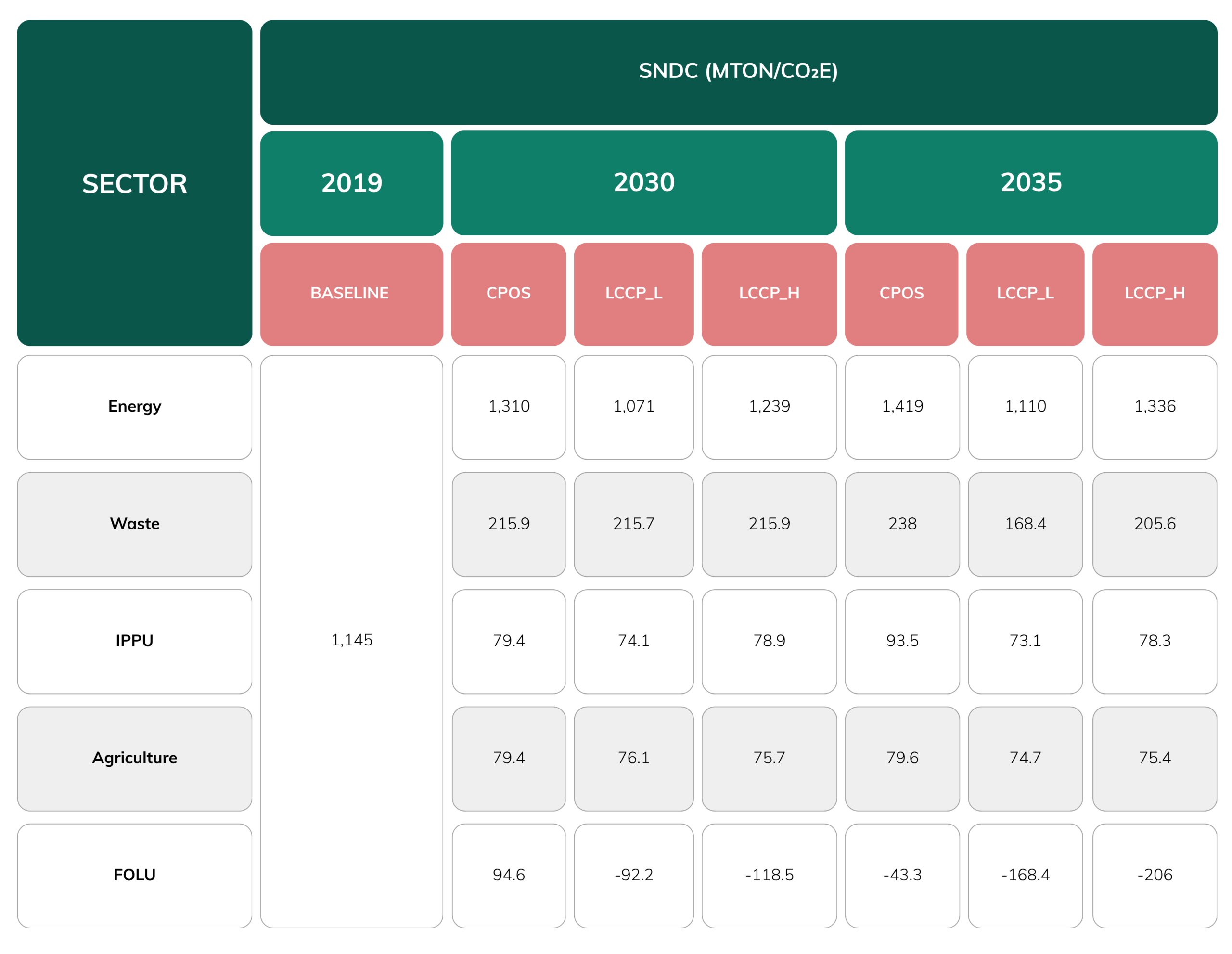
The reduction targets in the Second NDC demonstrate a more equitable and ambitious effort in the global context. However, according to IESR, these targets still need strengthening as they are less ambitious than the National Long-Term Development Plan (RPJPN) 2025-2045 target of 760 million tons of CO₂e by 2035.
In addition to setting reduction targets, the Second NDC also emphasizes the implementation process and the financing sources for these efforts. The Second NDC focuses on:
- Strengthening international cooperation under the Article 6 mechanism.
- Integrating carbon pricing to boost climate finance.
- Linking public commitments with private sector investment.
In other words, the Second NDC is not merely Indonesia’s climate plan; it is a roadmap for accelerating the green economy.
Climate Finance for Second NDC Implementation
To meet the new emission reduction targets, Indonesia is projected to require massive climate investments, totaling approximately IDR 7,552.5 trillion. This cost covers needs in the energy, agriculture, FOLU (Forestry and Other Land Use), and waste sectors, and does not yet include the needs of the IPPU (Industrial Process and Product Use) sector.
Funding of this magnitude must be sourced from various channels, including bilateral and regional cooperation, as well as international schemes like carbon markets, global climate funds, and direct private investment.
This structure opens up opportunities for result-based finance models and international collaborations, such as:
- The Joint Crediting Mechanism (JCM) with Japan.
- Mutual Recognition Agreements (MRA) with various global carbon standards.
- Result-based payment schemes.
The climate finance structure outlined in the Second NDC represents a significant opportunity for investors to enter the Indonesian carbon market.
The Carbon Market Pillar: Presidential Regulation 110/2025 as the Operational Framework
The Second NDC does not stand alone. It strengthens the foundation laid by Presidential Regulation No. 110 of 2025 on Carbon Pricing, which serves as the legal umbrella regulating the pricing and trading of carbon in Indonesia.
Through the carbon pricing framework, Indonesia establishes five main instruments for integrating the carbon pricing:
- Carbon Trading: A Cap-and-Trade mechanism (Emission Trading) between businesses with regulated emission limits.
- Project-Based Offsets: Creation of Carbon Units (CUs) from mitigation projects (such as reforestation, renewable energy) for both voluntary and compliance markets.
- Result-Based Payment: Incentives for measurable and verified emission reductions.
- Carbon Levy: The application of taxes or levies on commodities or activities that produce high emissions, creating a disincentive.
- Internationally Transferred Mitigation Outcomes (ITMO): The transfer of emission reduction results under Article 6 of the Paris Agreement.
The Second NDC aligns these mechanisms with the global UNFCCC accounting system to ensure every reduced ton of CO₂ in Indonesia is recorded, verified, and monetized. This means the NDC is now not just a policy document, but a financial framework to accelerate the national carbon market.
International Support and Carbon Financing
One of the main highlights of Indonesia’s Second NDC is the strengthening of international cooperation.
Under Article 6 of the Paris Agreement, countries can exchange mitigation outcomes, known as ITMOs (Internationally Transferred Mitigation Outcomes). Indonesia’s move to sign MRAs with other countries and global carbon standards, such as Japan, Gold Standard, Global Carbon Council, Plan Vivo, and other institutions, places Indonesia at the forefront of nations ready for cross-border crediting.
This framework allows projects in Indonesia to:
- Receive direct foreign investment with strong legal certainty.
- Connect with international carbon credit buyers.
- Be recorded in transparent systems like the National Registry System (SRN-PPI) and the IDXCarbon carbon exchange.
Thus, the Second NDC formalizes Indonesia’s readiness to host globally funded international projects, from forest restoration to the decarbonization of emission-intensive industries.
From Ambition to Investment Opportunity
Indonesia’s Second NDC is a turning point in the national climate journey where emission targets converge with economic instruments, and sustainability transforms into an investment opportunity.
This is not merely a policy document, but an open invitation for collaboration between the government, investors, and project developers to realize Indonesia’s measurable and sustainable climate targets. At TruCarbon, we view the Second NDC not just as a promise to be monitored, but as a market to be built.
TruCarbon serves as a strategic partner to bridge government commitment with private investment, ensuring your projects are validated, verified, and ready for monetization in both global and domestic markets.
Contact our team for a consultation on potential carbon projects that can help you enter the carbon market and make an impact on both your business and the environment.