


In recent years, sustainability has become a concern in the business world. Companies are no longer evaluated solely based on financial performance, but also on how they manage their environmental and social impacts. As a result, demand for companies to provide GHG Inventories Reports, ESG Reports, and Sustainability Reports has increased.
To support these practices, various emission reporting standards have been developed. However, the growing variety of standards can make it difficult for companies to determine which ones to use. Each standard serves a different purpose, from measuring greenhouse gas emissions to disclosing sustainability performance and climate-related risks.
In this article, we will explore several emissions reporting standards that support the development of sustainability reporting, ESG reporting, and GHG inventory, and how they are used by companies in practice.
What are Emissions Reporting Standards?
Emission reporting standards can be thought of as the equivalent of financial accounting standards for carbon emissions. Just as financial reporting standards ensure that companies report financial data consistently and transparently, emission reporting standards ensure that climate-related claims, such as carbon reduction targets or net-zero commitments, are supported by credible and comparable data.
These standards provide the rules for:
- Boundary Setting (The “Where”)
Determining the scope of your carbon footprint. Standards help define organizational boundaries (which subsidiaries or joint ventures are included) and operational boundaries (which emission sources are counted). - Calculation (The “How”)
Carbon emissions are not measured directly with a single device. Instead, they are calculated by converting activity data, such as fuel consumption, electricity use, or waste generation, using emission factors. This process converts various activities into a standardized metric: tonnes of CO₂ equivalent (tCO₂e). - Disclosure (The “How It Is Reported”)
Once emissions are calculated, standards guide how the data should be reported. This ensures transparency in the methodology used, the scope of emissions reported, and how progress is tracked over time.
Type of Emissions Reporting Standards
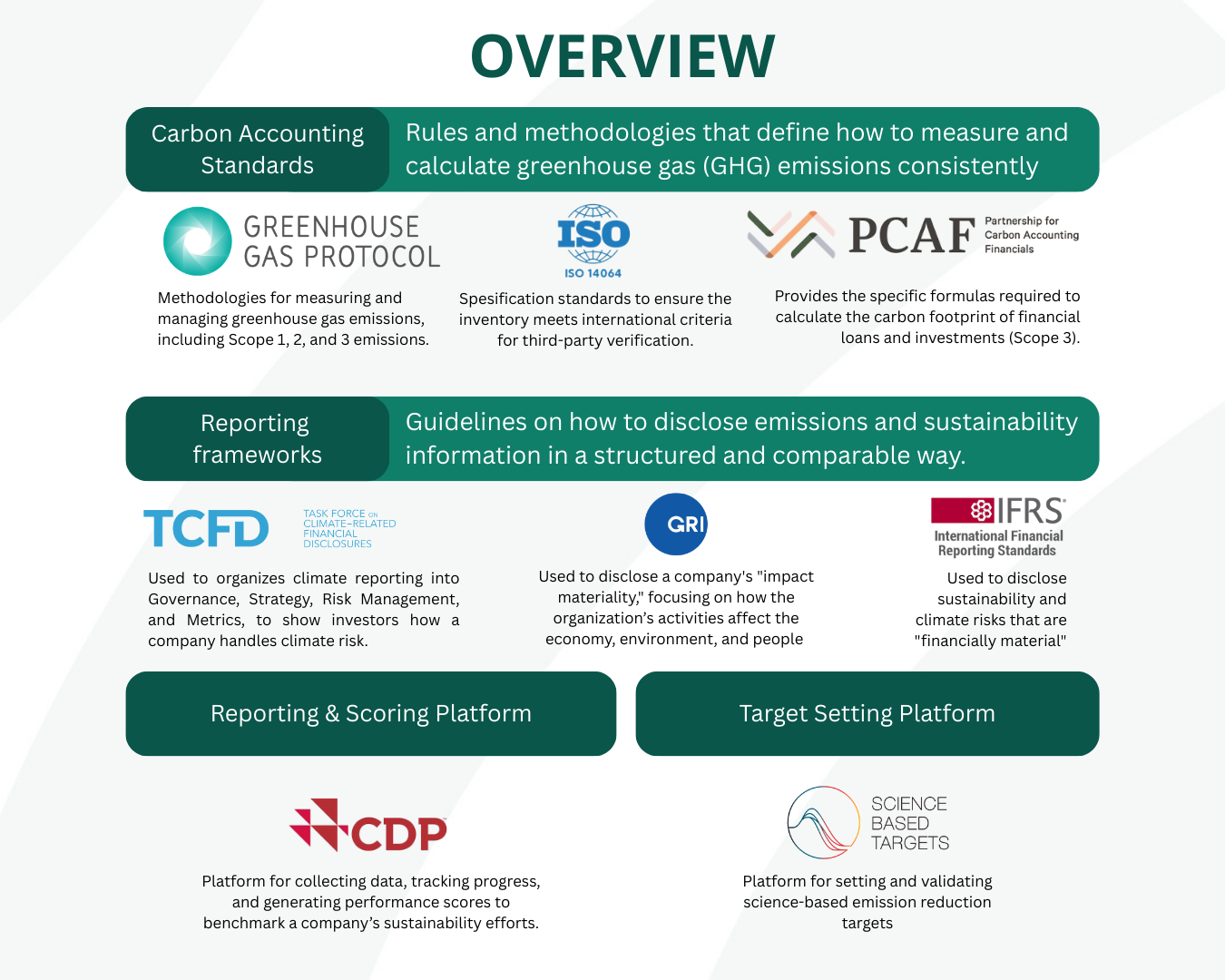
There are various emissions reporting standards that companies can use, depending on their specific needs. These standards are not mutually exclusive; in fact, they often complement each other to create more comprehensive reporting. Below are several types of emissions reporting standards and when they are typically used:
GRI (Global Reporting Initiative)
Developed by the Global Reporting Initiative, this standard focuses on the real-world impact a business has on both society and the environment. It includes sector-specific standards to ensure the data is relevant to your particular industry.
- Used when: You want to communicate your business’s impact comprehensively or are preparing full ESG and Sustainability Reports.
IFRS Sustainability (S1 & S2)
The International Financial Reporting Standards (IFRS) for sustainability are developed by the International Sustainability Standards Board (ISSB), these standards consist of:
- IFRS S1: Provides a general framework for disclosing sustainability-related risks and opportunities that could affect a company’s financial performance. Companies must disclose any sustainability factor that could impact enterprise value. This standard covers all ESG factors.
- Used when: You want to inform investors about overall sustainability issues (across ESG topics) may affect its financial performance and enterprise value.
- IFRS S2: Provides detailed disclosure requirements specifically for climate-related risks and opportunities, such as disclosures regarding greenhouse gas (GHG) emissions (Scope 1, 2, and 3), climate-related targets, and specific metrics that are not detailed in S1
- Used when: You want to inform investors about how climate-related risks, opportunities, and emissions may affect its financial performance and future strategy.
GHG Protocol
A global standard developed by the World Resources Institute (WRI) and the World Business Council for Sustainable Development (WBCSD). It is the foundational methodology for standardizing how emissions are calculated and managed.
- Used when: You are systematically identifying GHG emission sources, preparing a GHG Inventory, or setting reduction targets.
TCFD (Task Force on Climate-related Financial Disclosures)
This framework reports on the financial impacts of climate change on business value. It is built on four pillars: governance, strategy, risk management, and metrics & targets. Notably, it serves as the foundation for the newer IFRS S2 standard.
- Used when: You want to manage climate risks in a structured way to support investment decision-making.
ISO (International Organization for Standardization)
These international standards focus on management systems to systematically handle environmental impacts. They emphasize internal processes, controls, and continuous improvement rather than just the final report.
- Used when: You need internationally verifiable emission calculations to support a formal GHG Inventory (e.g., ISO 14064, 14065, or 14067).
CDP (Carbon Disclosure Project)
CDP encourages companies to disclose environmental data (climate, water security, and deforestation) through standardized questionnaires that are then assessed and scored.
- Used when: You want to transparently present environmental performance to investors using a recognized assessment to strengthen your credibility.
SBTi (Science Based Targets initiative)
A global initiative that provides the methodologies and validation necessary for companies to set science-based emissions reduction targets. These targets ensure your company is aligned with the Paris Agreement’s goal of limiting global warming to 1.5°C.
- Used when: You want to set and validate credible, ambitious climate action targets.
PCAF (Partnership for Carbon Accounting Financials)
Specifically designed for the financial sector, PCAF provides standardized methodologies for banks and investors to measure and report emissions from their “financed activities,” such as loans and investment portfolios.
- Used when: You are a financial institution measuring the climate risk and emissions tied to your financing and investment portfolios.
These standards do not exist in isolation. In a sophisticated reporting cycle, a company might use the GHG Protocol to calculate data, align its strategy with TCFD, set future goals through SBTi, and finally disclose the progress via GRI or CDP. By choosing the right combination of standards, your company can move beyond mere compliance and turn sustainability into a competitive advantage.
Understanding Emissions Reporting Standards is only the beginning. The real challenge is implementing it.
Emissions reporting is not a one-time exercise completed at the end of the year. It is an ongoing cycle that requires coordination across teams, reliable data, and continuous improvement. These are the steps to implementing the standards:
- Define Your Scope: Decide if you are reporting for just the parent company or all subsidiaries. Identify your Scope 1 (direct), Scope 2 (energy), and Scope 3 (supply chain) activities.
- Select Your Primary Standards: Select the standards that fit best with the type of report you are preparing. For example, most companies use the GHG Protocol for the carbon accounting and IFRS/GRI for the final report.
- Collect Data: This is usually the hardest part where you need to gather utility bills, fuel receipts, supplier data, and so forth.
- Apply Emission Factors: Convert your activity data into CO₂ emissions using verified databases.
- Calculate your emissions: Aggregate the converted emissions across all activities and scopes to determine your total greenhouse gas (GHG) footprint.
- Verify and Disclose: Have your data checked by a third party and submit it to platforms like CDP or include it in your annual report.
Among these steps, the two most challenging parts are collecting data and applying emission factors. Gathering data often requires pulling information from multiple departments, facilities, and suppliers. This is especially difficult for Scope 3 emissions, which occur across the value chain and may rely on estimates. Once the data is collected, converting it into CO₂e using the correct emission factors adds another layer of complexity, as factors vary by geography, energy source, and fuel type. These challenges make manual carbon accounting time-consuming, error-prone, and difficult to scale.
However, in today’s digital era, companies no longer have to rely solely on manual processes. Digital carbon accounting tools are now available to help simplify and streamline emissions management.
Simplify the Process using a Digital Carbon Accounting Tool
By using digital carbon accounting tools, you can avoid juggling spreadsheets and save time. TruCount, developed by TruCarbon, is one of the digital carbon accounting tools that you can use to help simplify the process.
Using a platform like TruCount makes carbon accounting and reporting more efficient by:
- Calculating emissions once you input your activity data.
- Standardizing emission factors and calculation logic.
- Ensuring consistency with global emissions reporting standards.
- Supporting multi-entity and multi-location reporting, from manufacturing facilities to complex supply chains.
- Centralizing data from multiple departments and sites, making reporting more manageable and audit-ready.
- Providing an intuitive dashboard that analyzes your carbon emissions.
TruCount Free Trial
Currently, we offer a TruCount Free Trial for IDX-listed companies until 20 April 2026. This offer timeline is already aligned with the Sustainability Report deadline, so you can use it to start preparing earlier.
Claim your TruCount free trial today!
Contact us via WhatsApp or via email at zaky@trucarbon.co.