

The Indonesian Minister of Forestry signed Regulation No. 6 of 2026 on the Procedures for Carbon Trading through Forestry Sector Greenhouse Gas Emission Offsets on 6 April 2026, and the regulation was enacted on 13 April 2026. Commonly referred to as Permenhut 6/2026 (MOF Reg 6/2026), it revokes Permen LHK No. 7 of 2023 and operationalises Presidential Regulation No. 110 of 2025 (PR 110/2025) on Carbon Economic Value (Nilai Ekonomi Karbon, or NEK) inside the forestry sector. It is now the rulebook for how a forestry carbon project in Indonesia gets designed, certified, traded, monitored, and reported.
This article is a structured Permenhut 6/2026 summary of what changed, who is in scope, and what project developers, investors, and offtakers should pay attention to.
What is Permenhut 6/2026 in one paragraph?
Permenhut 6/2026 is the implementing regulation that translates Indonesia’s high-level carbon governance framework (PR 110/2025) into a working procedure for the forestry sector. It defines who is eligible to develop a carbon project, which forest areas qualify, how credits are validated and verified, when a developer needs ministerial recommendation, what ESG safeguards are mandatory, how international transfers are controlled through Authorisation (Otorisasi) and Corresponding Adjustment, and how transactions are reported and taxed. In practical terms, it is the difference between knowing Indonesia has a carbon market and knowing exactly how a credit gets issued in it.
How is Permenhut 6/2026 different from Permen LHK 7/2023?
- Trading Mechanism
Permenhut 6/2026: Offset only (project-based)
Permen LHK 7/2023: Both emission trading (cap-and-trade) and offset
- Central registry
Permenhut 6/2026: Carbon Unit Registry (Sistem Registri Unit Karbon, or SRUK)
Permen LHK 7/2023: National Climate Change Control Registry (SRN PPI)
- Export volume control
Permenhut 6/2026: MOF assesses based on NDC achievement needs (substantive review)
Permen LHK 7/2023: Quota formula in regulation annex
- Reporting frequency
Permenhut 6/2026: Electronic submission, evaluated at least once per year
Permen LHK 7/2023: Monthly reporting from PBPH holders
The first point is the most consequential. Indonesia has narrowed the forestry sector framework to a single mechanism: project-based offsets. Cap-and-trade is gone from this regulation. The second row is operationally critical: registry data has to migrate from SRN PPI to SRUK, and the regulation provides for an interim period (more on that under Transitional Rules below).
What is the scale of Indonesia’s forestry carbon ambition under Permenhut 6/2026?
The regulation mandates the Minister of Forestry to develop and publish a Carbon Trading Roadmap with concrete area targets:
- At least 48.69 million hectares of forest area for emission reduction activities.
- At least 3.5 million hectares of critical and degraded land for carbon absorption via climate change mitigation.
The roadmap also defines GHG baselines and absorption targets, offset periods, performance measurement timelines, and harmonisation rules with other NEK instruments. Until the new roadmap is published (which must happen within one year of enactment under Article 59), existing forestry carbon activities continue to follow the prior carbon roadmap under MOF Decree No. SK.1027/MENLHK/PHL/KUM.1/9/2023.
There is also a specific conservation area opportunity. According to the Ministry of Forestry’s own briefing on the regulation, deforested and degraded conservation zones cover roughly 1.27 million hectares across Strict Nature Reserves (Kawasan Suaka Alam), Nature Conservation Areas (Kawasan Pelestarian Alam, or KPA), and Game Reserves (Taman Buru), with carbon sequestration potential between 4.5 and 50 tonnes CO2-equivalent per hectare per year.
Who can participate in forestry carbon trading under Permenhut 6/2026?
Article 6(1) lists five eligible categories of Business Actors (Pelaku Usaha):
- Holders of a Forest Utilisation Business License (Perizinan Berusaha Pemanfaatan Hutan, or PBPH) and other forest management rights.
- Holders of a Social Forestry Management Approval (Persetujuan Pengelolaan Perhutanan Sosial).
- Customary law communities (masyarakat hukum adat) hold a customary forest status determination.
- Holders of private forest registration (hutan hak).
- Holders of a Carbon Environmental Services Utilisation Business License (PB-PJL Karbon).
Two consequences follow:
First, accountability stays with the permit holder. Article 8 provides that where a PBPH or PB-PJL Karbon holder cooperates with third parties (including investors), the permit holder remains the responsible party for the carbon trading activity. Investors and partners can structure the deal, but the regulatory line of responsibility does not move.
Second, community-based participation is no longer fully standalone. Under Article 6(2), social forestry groups, customary communities, and private forest holders must work with a registered partner, and that partner is itself subject to formal registration requirements. This goes beyond the experience-based requirement under the 2023 framework and turns it into a formal qualification layer.
The regulation also opens the door to landscape-scale aggregation through an Integrated Area Development scheme, allowing multiple smallholders or community groups to undertake mitigation activities jointly across a defined landscape, or operate independently if they prefer.
Which forest areas are eligible for carbon projects?
Article 9(1) lists five categories of eligible project areas:
- Production forests (including convertible production forests and utilisation blocks within protected forests) that are already covered by a relevant licence or management right.
- Utilisation zones or blocks within Nature Conservation Areas (KPA) and Game Reserves (Taman Buru) that are not yet encumbered by a management right, business licence, or cooperation agreement.
- Customary forests (hutan adat).
- Private forests (hutan hak).
- State land outside designated forest areas.
There is one important constraint on jurisdictional programmes. Article 30(4) provides that, when implementing a Jurisdiction-Based Programme, the government will not undertake carbon trading on areas already covered by an existing licence (such as a PBPH or hutan adat) without first obtaining the consent of the relevant rights holder. This is the regulatory expression of the nesting principle: jurisdictional and project-level claims have to be reconciled before, not after, a transaction.
How does a forestry carbon project get certified under Permenhut 6/2026?
The regulation defines two parallel certification paths.
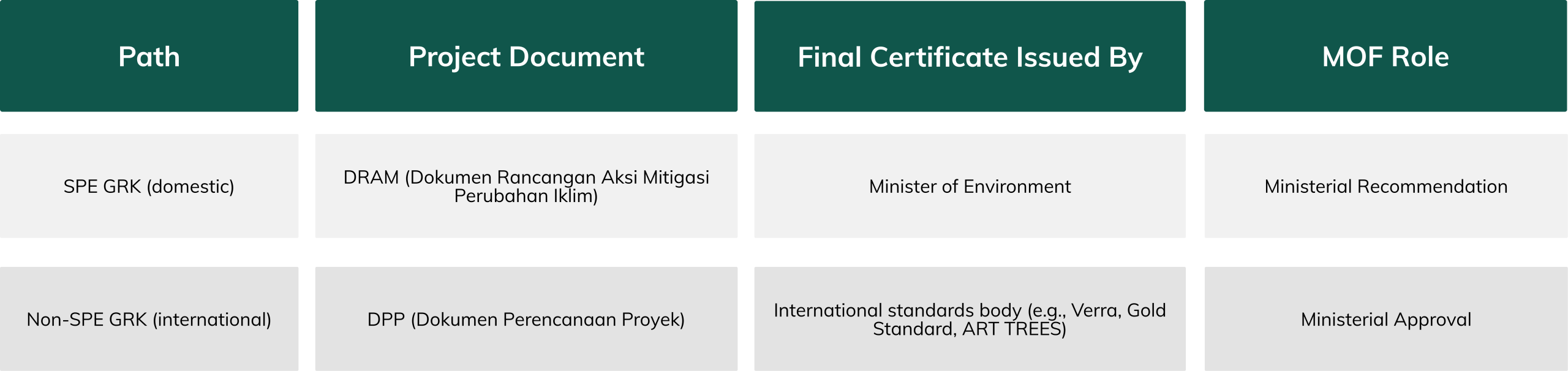
For a domestic credit (SPE GRK, or Sertifikat Pengurangan Emisi Gas Rumah Kaca):
- The developer prepares a DRAM and submits it through SRUK (Articles 11 and 12).
- The DRAM must include a Free, Prior, and Informed Consent (Padiatapa) plan, a benefit-sharing arrangement agreed with local communities, and a biodiversity and reversal-risk management plan. Permit holders may engage technical experts in document preparation under Article 13.
- The Ministry of Forestry checks document completeness within a maximum of 5 working days. If incomplete, the developer has up to 5 working days to fix it (Article 14).
- The DRAM is validated by an independent accredited validation body, mitigation activities are implemented, and emission reductions are verified by an independent verifier.
- Before issuing a recommendation, the Ministry checks the developer’s compliance history (Article 16(2)). If the developer is currently subject to administrative sanctions, the application is rejected and cannot be resubmitted until the sanction is lifted (Article 16(7)).
- If documents are complete and no sanctions apply, the substantive review and ministerial recommendation process runs for up to 14 working days (Article 16). The Minister of Environment then issues the SPE GRK certificate based on that recommendation.
For an internationally certified credit (non-SPE GRK), the developer must obtain prior approval from the Minister of Forestry before proceeding with certification under an international standard. Approval is granted on submission of a DPP plus supporting validation and verification documents, and is valid for 6 months (Article 24(1)). Within that window, the developer must engage with the relevant international standards body.
The non-obvious step in both pathways is the compliance-history screen. For developers, this means compliance posture (across permits, environmental obligations, and prior carbon project conduct) is now a project-eligibility input, not just an operational matter.
How does Indonesia control international transfers and corresponding adjustments?
Permenhut 6/2026 confirms that forestry carbon units can be used for international mitigation purposes, including toward another country’s NDC, but only with Authorisation (Otorisasi) and a Corresponding Adjustment to Indonesia’s NDC accounting.
The procedure (Articles 25 and 26) is sequential:
- The developer submits an application to the Minister of Forestry for a recommendation on Authorisation, accompanied by the relevant carbon trading cooperation agreement.
- The Minister of Forestry assesses the proposed export volume against Indonesia’s NDC achievement needs and issues a recommendation within a maximum of 7 working days (Article 26).
- The developer then uses that recommendation to apply for definitive Authorisation from the Minister of Environment, who is the official with authority over the national environmental management portfolio.
The recommendation is not automatic. It can be granted in full, granted for a specified volume only, or refused based on national climate priorities. For offtakers, especially foreign buyers and Article 6 transaction structures, this means the Corresponding Adjustment line in a sales contract is a discretionary administrative decision, not a clerical step. Project pipelines that depend on full international transferability need to factor that discretion into their commercial assumptions.
The signal is clear: Indonesia is positioning forestry carbon credits for Article 6 compliance markets, with a defined administrative pathway and a 7 working day MOF recommendation window to get them there.
What ESG safeguards are mandatory under Permenhut 6/2026?
This is the part of the regulation most likely to change how projects are scoped on day one.
Article 28 sets out the social and environmental safeguards that every project must apply:
- Compliance with applicable laws and alignment with national forest governance.
- Recognition and protection of indigenous and local community rights.
- Biodiversity conservation.
- Reversal-risk management and leakage reduction.
At the design stage, a DRAM must include a Padiatapa (FPIC) plan, a benefit-sharing arrangement agreed with local communities, biodiversity management plans, risk-reversal plans, identification of the project proponent, and a demonstration of additionality.
On the operational side, developers must maintain a documented risk management system covering both technical and social risks, and submit periodic reports to the Ministry (Article 29). Article 48 mandates a public grievance mechanism, and Article 56 obliges the government to support community groups and customary communities through capacity-building and accompaniment across planning, implementation, and reporting stages, including ESG risk identification and mitigation.
The shift here is structural. Under Permen LHK 7/2023, ESG content was largely a function of the certification standard a developer chose. Under Permenhut 6/2026, ESG is the regulatory baseline. It applies whether a project is going through the SPE GRK, an international standard, or both.
Who can validate and verify projects under Permenhut 6/2026?
Validation and verification must be conducted by independent legal entities accredited at the national level (Articles 41 and 42). Where a project uses an international registration scheme, the body must hold international accreditation.
Two specific provisions matter:
- Validation and verification bodies operating in Indonesia must employ Indonesian workers with internationally recognised qualifications (Article 42(1)(d)). This is a localisation requirement that affects how international V&V firms staff their Indonesian engagements.
- For projects undertaken by social forestry groups, customary law communities, and private forest holders, validation and verification may also be carried out by individual experts, provided those experts are registered with internationally recognised accreditation bodies. This is a deliberate accommodation for community-scale projects, where engaging a full accredited body has historically been the rate-limiting step on issuance.
How is monitoring, reporting, and evaluation handled?
Reporting is centralised and fully electronic. Under Article 54, developers must submit project implementation reports through an electronic information system, covering at a minimum:
- Realisation of carbon trading activities through the offset mechanism.
- Community participation and implementation of the agreed benefit-sharing arrangement.
- Follow-up actions on community grievances.
Article 55 then provides that the Ministry of Forestry conducts evaluation and field audits at least once per year, covering infrastructure realisation, methodology compliance, and carbon potential. Article 48 requires the Minister to maintain a public grievance mechanism, accessible both manually and electronically.
The frequency change matters. Under Permen LHK 7/2023, PBPH holders reported monthly. Under Permenhut 6/2026, reporting is continuous via the electronic system, but formal evaluation and audit are at least annual.
What is the Jurisdictional Approach, and what does “nesting” mean in Permenhut 6/2026?
Permenhut 6/2026 explicitly recognises a Jurisdictional Approach. The Minister of Forestry and provincial governors may run a Jurisdiction-Based Programme (Program Berbasis Yurisdiksi) at the national or provincial level. As noted earlier, Article 30(4) prevents the government from claiming credits from areas already under a licence or customary forest status without the rights holder’s consent.
The regulation introduces a mandatory nesting requirement: alignment of emission reduction planning and implementation across the national, provincial, and project levels, with the explicit purpose of preventing double-counting and overlapping claims over the same carbon units.
In plain terms, a project-level credit cannot also be claimed at the jurisdictional level. The accounting has to net out, and the regulation puts the obligation on developers and the relevant jurisdictional authority to make the alignment work.
What about non-tax state revenue (PNBP)?
Under Article 46, carbon trading transactions in the forestry sector remain subject to Non-Tax State Revenue (Penerimaan Negara Bukan Pajak, or PNBP) in the form of forest utilisation charges for carbon sequestration and storage activities.
Two refinements that matter:
- PNBP now applies to transactions under offset-based carbon trading specifically. With cap-and-trade removed from this regulation, the fiscal scope is narrower and clearer.
- Payments are processed through SIPNBP (Sistem Informasi Penerimaan Negara Bukan Pajak), the national PNBP information system, which standardises the fiscal pathway.
What are the transitional rules under Permenhut 6/2026?
The regulation in Permenhut 6/2026 provides three transitional anchors:
- Existing forestry carbon activities will continue to follow the prior carbon roadmap (MOEF Decree No. SK.1027/MENLHK/PHL/KUM.1/9/2023) until a new roadmap is issued (Article 59).
- Until SRUK is fully operational, project registration and document recording can run through the Ministry’s internal electronic system (Article 60).
- Developers and mitigation action proponents already in DRAM/DPP validation, implementation, verification, or reporting stages, including those holding carbon units that have not yet been transacted, must resubmit their activity reports to the Minister of Forestry within 6 months of promulgation. Because the regulation entered into force on 13 April 2026, the deadline is 13 October 2026 (Article 61).
For developers with active projects, the 13 October 2026 deadline is the most operationally significant clause. It is short, and it requires reconciling existing project documentation with the new DRAM, ESG safeguard, and SRUK requirements.
What does Permenhut 6/2026 mean for project developers and investors?
Key points that project developers and investors must take note of in the new Permenhut 6/2026:
- Regulatory certainty has improved. The lifecycle is now end-to-end documented: design and DRAM submission, 5 working days for completeness check, validation, 14 working days for the SPE GRK recommendation, verification, registry recording, and (if needed) Authorisation and Corresponding Adjustment with a 7 working day MOF recommendation window. Investors evaluating Indonesian forestry carbon assets in 2026 are working with a meaningfully more legible procedural map than they had in 2023.
- MOF discretion is now a structural variable to model. Compliance history checks before recommendation issuance, NDC-based assessment of international transfer volumes, and the ability to refuse Authorisation on national climate priorities are all points where a project’s commercial outcome depends on a ministerial decision. That is not a deal-breaker. It is a factor that needs to be priced.
- ESG is now table stakes, not a premium feature. FPIC, benefit-sharing, additionality demonstration, biodiversity management, reversal-risk planning, a functioning grievance mechanism, and Indonesian-qualified V&V personnel are not optional design choices. They are the minimum content for issuance.
The remaining open variables are the rollout of SRUK as the unified registry, the publication of the new Carbon Trading Roadmap, and the operationalisation of the Methodology Panel. Until those are live, the framework’s real-world performance is partly a function of how quickly the supporting infrastructure follows the regulation.
Work with TruCarbon on your nature-based project
Permenhut 6/2026 is the rulebook. Translating that rulebook into a verified, issuable, and bankable carbon project is a different problem.
If you are a landowner or licence holder (PBPH, social forestry, hutan adat, hutan hak, or PB-PJL Karbon) sitting on forest, peatland, or mangrove area that could qualify under Article 9, TruCarbon develops nature-based projects end-to-end: feasibility and additionality assessment, DRAM or DPP preparation, Padiatapa (FPIC) and benefit-sharing design, accredited validation and verification, SRUK registration, SPE GRK or international issuance (Verra, Gold Standard, ART TREES), and offtake.
If you are an investor or corporate buyer looking for a high-integrity Indonesian forestry carbon supply, we can share the active project pipeline, eligibility status under the new framework, and how we structure deals around MOF discretion on Authorisation and Corresponding Adjustment. Learn more about how we conduct nature-based carbon projects.
Permenhut 6/2026 Quick FAQ
- When was Permenhut 6/2026 signed, and when did it enter into force?
Signed on 6 April 2026 and promulgated on 13 April 2026. The 6-month transitional reporting deadline therefore lands on 13 October 2026.
- What does Permenhut 6/2026 replace?
Permen LHK No. 7 of 2023, the previous procedural framework for forestry carbon trading.
- What is the difference between SPE GRK and non-SPE GRK?
SPE GRK (Sertifikat Pengurangan Emisi GRK) is Indonesia’s domestic GHG Emission Reduction Certificate, issued by the Minister of Environment after a Ministerial Recommendation from the Minister of Forestry. Non-SPE GRK refers to credits certified under international standards such as Verra, Gold Standard, or ART TREES, which require prior Ministerial Approval from the Minister of Forestry, valid for 6 months.
- What are the headline area targets under Permenhut 6/2026?
The Carbon Trading Roadmap targets at least 48.69 million hectares of forest for emission reduction and at least 3.5 million hectares of critical or degraded land for carbon absorption. The Ministry separately identifies approximately 1.27 million hectares of deforested or degraded conservation areas as a specific opportunity.
- What are the processing timelines I should know in the Permenhut 6/2026?
5 working days for DRAM document completeness check (Article 14); 14 working days for the substantive SPE GRK recommendation review (Article 16); 7 working days for the international Authorisation recommendation (Article 26); 6 months validity for non-SPE GRK approval (Article 24).
- Do international transfers still require a Corresponding Adjustment under Permenhut 6/2026?
Yes. International transfers require a Ministerial Recommendation from the Minister of Forestry (issued within 7 working days under Article 26), followed by definitive Authorisation from the Minister of Environment. The recommendation is discretionary, assessed against Indonesia’s NDC requirements.
- Is FPIC mandatory?
Yes. Free, Prior, and Informed Consent (Padiatapa) is part of the mandatory DRAM content under Articles 11 and 12, and is reinforced by the safeguard baseline under Article 28.
- What is the deadline for ongoing projects to align with the new framework?
13 October 2026 (Article 61), six months after the regulation’s promulgation on 13 April 2026.
Source:
- Peraturan Menteri Kehutanan Nomor 6 Tahun 2026 (full PDF), Direktorat Jenderal Peraturan Perundang-undangan Kementerian Hukum
- ARMA Law, “From Framework to Execution: Forestry Carbon Offsets under MOF Regulation No. 6 of 2026”
- Eunomia (Veritask), “Peraturan Menteri Kehutanan Nomor 6 Tahun 2026 Mengubah Perdagangan Karbon Kehutanan melalui Skema Offset dan Kewajiban ESG”
- ANTARA News, “RI perkuat aturan perdagangan karbon hutan lewat Permenhut 6/2026”
- ANTARA News, “Kemenhut: Permenhut Nomor 6 Tahun 2026 mengakomodasi masyarakat lokal”
- Justisio, “Panduan Lengkap Perdagangan Karbon Sektor Kehutanan: Mekanisme dan Peran dalam Peraturan Menteri Kehutanan No. 6/2026”
- Ecobiz Asia, “Analisis Permenhut 6/2026: Kredit Karbon Kehutanan Siap Masuk Pasar Internasional”
- Liputan6, “Pemerintah Terbitkan Permenhut 6/2026 soal Aturan Perdagangan Karbon Hutan”
- Presidential Regulation No. 110 of 2025 (PR 110/2025) on Carbon Economic Value and National GHG Emission Control