


Companies are now evaluated on how they manage climate and social impacts alongside financial performance. Disclosures need to satisfy three different audiences at once: regulators (OJK in Indonesia, MAS in Singapore, ASIC in Australia), investors (who increasingly read IFRS S2 and CDP scores), and customers and partners (who often look at GRI-aligned Sustainability Reports).
Each standard answers a different question. This guide walks through the eight that matter most for Indonesian and regional companies, what each one is for, when to use it, and how they fit together in a single reporting cycle.
What Are Sustainability Disclosure and Reporting Standards?
Sustainability disclosure and reporting standards are the equivalent of accounting standards for non-financial data. Just as financial reporting standards make sure companies report financial data consistently and transparently, sustainability disclosure and reporting standards make sure sustainability claims (GHG inventories, carbon-reduction targets, net-zero commitments, Scope 3 disclosures, biodiversity and social-impact statements) are backed by credible and comparable data. The category covers three distinct types of output: GHG Inventory Reports, ESG Reports, and Sustainability Reports, each governed by a different combination of the standards described below.
These standards govern three things:
- Boundary Setting (The “Where”)
Determining the scope of your carbon footprint. Standards define organisational boundaries (which subsidiaries or joint ventures are included) and operational boundaries (which emission sources are counted) - Calculation (The “How”)
Carbon emissions are not measured directly with a single device. Instead, they are calculated by converting activity data, such as fuel consumption, electricity use, or waste generation, using emission factors. This process converts various activities into a standardized metric: tonnes of CO₂ equivalent (tCO₂e). - Disclosure (The “How It Gets Reported”)
Standards then govern how the data is reported, what level of methodological transparency is required, what scope of emissions must be disclosed, and how progress is tracked year on year.
Types of Sustainability Disclosure and Reporting Standards
These standards are not mutually exclusive. Most reporting cycles use three or four together: one to calculate, one to set targets, one to disclose to investors, and one to publish externally. Below are the eight that matter for Indonesian and Southeast Asian companies.
GRI (Global Reporting Initiative)
GRI focuses on a company’s real-world impacts on society and the environment, not only on its financial-statement-relevant risks. The umbrella framework is the GRI Standards, comprising Universal Standards (GRI 1, 2, 3), Sector Standards (e.g. GRI 11 for Oil and Gas), and Topic Standards (e.g.GRI 305: Emissions).
Used when: You want to communicate your company’s impacts comprehensively to a broad stakeholder base, or you are preparing a full Sustainability Report under OJK POJK 51/2017 (for Indonesia).
IFRS Sustainability (S1 & S2)
The International Financial Reporting Standards (IFRS) for sustainability are developed by the International Sustainability Standards Board (ISSB), part of the IFRS Foundation. There are two:
- IFRS S1 (General Requirements for Disclosure of Sustainability-related Financial Information): provides a general framework for disclosing sustainability-related risks and opportunities that could affect a company’s financial performance. Companies must disclose any sustainability factor that could reasonably affect enterprise value. Covers all ESG factors.
Used when: You want to inform investors how sustainability issues across ESG topics may affect the company’s financial performance and enterprise value. - IFRS S2 (Climate-related Disclosures): provides detailed disclosure requirements specifically for climate-related risks and opportunities, including disclosure of greenhouse gas (GHG) emissions (Scope 1, 2, and 3), climate-related targets, and climate metrics not detailed in S1.
Used when: You want to inform investors how climate-related risks, opportunities, and emissions may affect the company’s financial performance and forward strategy.
Both standards became effective for annual reporting periods beginning on or after 1 January 2024 in adopting jurisdictions. As of 2026, jurisdictions including Singapore, Australia, the United Kingdom, Brazil, and Japan have begun phasing in mandatory adoption. Indonesia has not yet mandated IFRS S1/S2, but voluntary adoption is increasingly common among IDX-listed companies that report internationally.
GHG Protocol
The GHG Protocol is the most widely used global standard for measuring and managing greenhouse gas emissions. It was developed by the World Resources Institute (WRI) and the World Business Council for Sustainable Development (WBCSD). The two standards that matter most are:
- GHG Protocol Corporate Standard (Corporate Accounting and Reporting Standard): the foundational methodology for Scope 1 and Scope 2 emissions inventories at the organisational level.
- GHG Protocol Corporate Value Chain (Scope 3) Standard: covers the 15 categories of Scope 3 emissions across upstream and downstream activities.
Used when: You are systematically identifying GHG emission sources, preparing a GHG Inventory, or setting reduction targets.
TCFD (Task Force on Climate-related Financial Disclosures)
The TCFD Recommendations, published in 2017, introduced four pillars (Governance, Strategy, Risk Management, and Metrics & Targets) for disclosing climate-related financial risks and opportunities. The TCFD itself was disbanded in October 2023 and its monitoring responsibilities transferred to the IFRS Foundation. The four-pillar framework now lives inside IFRS S2; companies that have adopted IFRS S2 are considered TCFD-aligned.
- Used when: You want to communicate how climate risks and opportunities are managed in a structured way that investors recognise. In practice, TCFD-aligned reporting is now done through IFRS S2.
ISO 14064 Family
ISO (International Organization for Standardization) is an international standards focus on management systems to systematically handle environmental impacts. They emphasize internal processes, controls, and continuous improvement rather than just the final report. ISO publishes a family of standards for GHG quantification and verification. These are not the same standard, and they are often confused:
- ISO 14064-1 (Specification with guidance at the organization level): for org-level GHG inventories. The closest ISO equivalent of the GHG Protocol Corporate Standard.
- ISO 14064-2 (Specification with guidance at the project level): for GHG project-level quantification, used by carbon-credit project developers.
- ISO 14064-3 Specification with guidance for the verification and validation of GHG assertions): for auditors verifying GHG inventories.
- ISO 14065: requirements for verification bodies (for accreditation), not for emitters themselves.
- ISO 14067: carbon footprint of products (life-cycle product-level).
Used when: You need an internationally accepted methodology for a GHG inventory or product-level footprint, often for export-market compliance, EU CBAM-related disclosures, or formal third-party verification.
CDP (formerly the Carbon Disclosure Project)
CDP, rebranded from “Carbon Disclosure Project” in 2013, runs an annual environmental disclosure questionnaire across climate, water security, and forests. Submissions are scored from D– to A. Major institutional investors representing over USD 130 trillion in assets request CDP disclosure from portfolio companies.
Used when: You want to disclose to investors and customers using a recognised, scored framework, and you need a comparable rating that institutional buyers and procurement teams can benchmark across companies.
SBTi (Science Based Targets initiative)
The Science Based Targets initiative provides the methodologies and validation needed for companies to set emission-reduction targets aligned with the Paris Agreement’s goal of limiting global warming to 1.5°C. The current flagship document is the SBTi Corporate Net-Zero Standard.
Used when: You want to set, validate, and publicly commit to a climate target your investors and customers will trust. SBTi validation is increasingly a procurement requirement in regulated supply chains (apparel, electronics, food).
PCAF (Partnership for Carbon Accounting Financials)
PCAF develops the Global GHG Accounting and Reporting Standard for the Financial Industry, the financial-sector counterpart to the GHG Protocol Scope 3 Standard. The Standard has three parts:
- Part A: Financed Emissions (loans and investments held on the balance sheet).
- Part B: Facilitated Emissions (capital-markets underwriting and bond issuance).
- Part C: Insurance-Associated Emissions (insurance and reinsurance underwriting portfolios).
Used when: You are a bank, asset manager, or insurer measuring the climate footprint of your financing, facilitation, or insurance activities. Indonesian banks reporting under POJK 51/2017 increasingly use PCAF for the financed emissions section of their Sustainability Report.
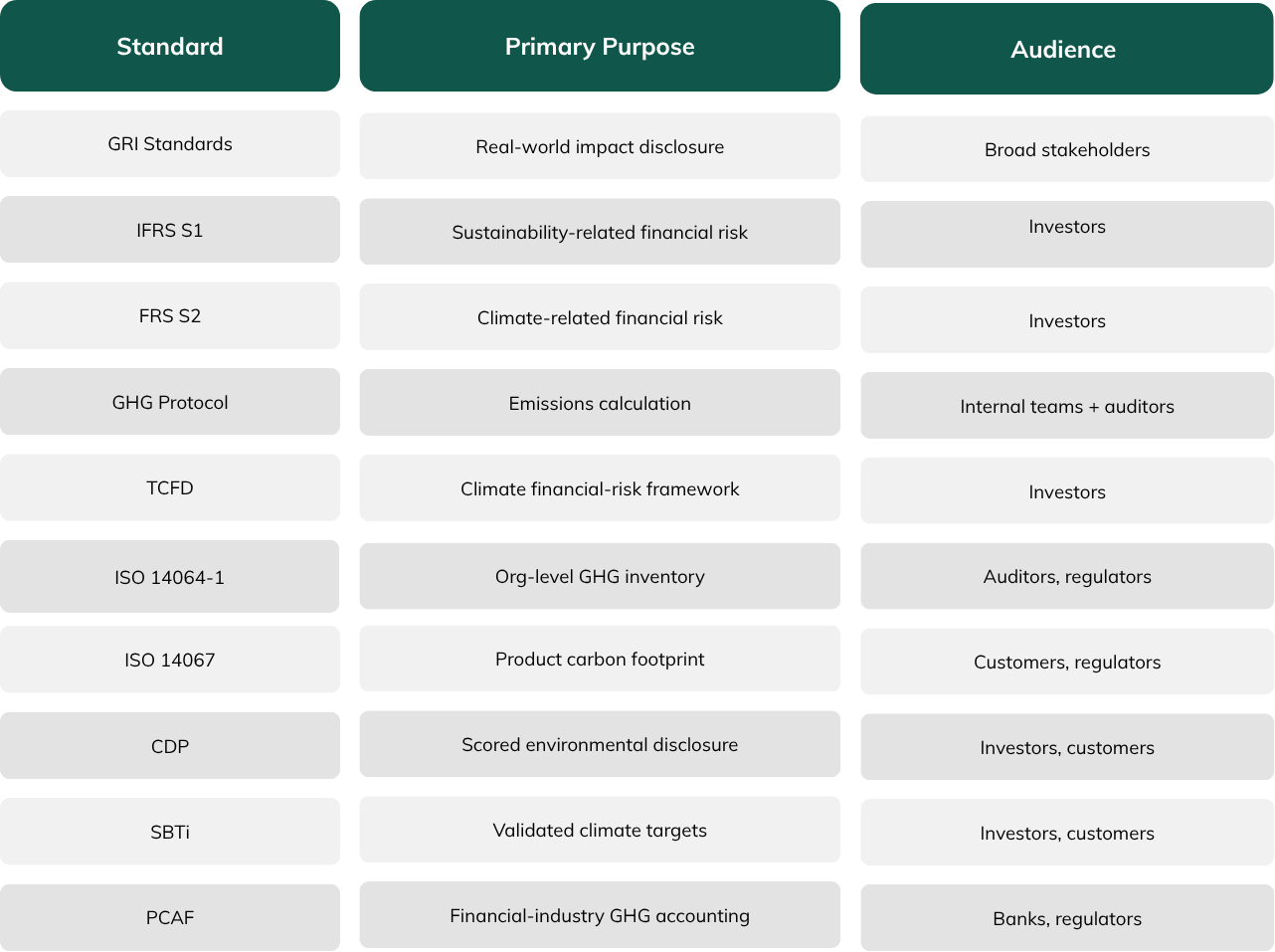
At a Glance: Which Standard for What?
These standards do not exist in isolation. In a sophisticated reporting cycle, a company might use the GHG Protocol to calculate data, align its strategy with TCFD, set future goals through SBTi, and finally disclose the progress via GRI or CDP. By choosing the right combination of standards, your company can move beyond mere compliance and turn sustainability into a competitive advantage.
How These Standards Get Implemented
Sustainability Disclosure and Reporting is not a one-time exercise at year-end. It is a recurring cycle that takes coordination across teams, reliable data, and incremental improvement. The steps:
- Define Your Scope: Decide whether you are reporting at parent-only or consolidated-group level, and which subsidiaries or joint ventures are in. Identify Scope 1 (direct), Scope 2 (purchased energy), and Scope 3 (value-chain) activities.
- Select Your Standards: Pick the standards that fit your audience. Most companies use the GHG Protocol for the carbon accounting itself, GRI and/or IFRS S2 for the published report, and SBTi for the target.
- Collect Activity Data: This is where most projects stall: utility bills, fuel receipts, supplier data, freight records, employee commuting estimates, and waste records all sit in different teams and systems.
- Apply Emission Factors: Activity data gets converted to CO₂e using verified factor databases (DEFRA, IEA, US EPA, IPCC, and SIH-N for Indonesia).
- Aggregate and calculate: Roll converted emissions up across all categories and scopes into a complete GHG inventory.
- Verify and Disclose: Have the data third-party verified (typically against ISO 14064-3 or AA1000AS) and submit through the appropriate channel: annual report, OJK Sustainability Report, CDP questionnaire, or carbon registry submission.
The two steps where companies most often get stuck are data collection and emission-factor application. Activity data sits across multiple departments, facilities, and suppliers, especially for Scope 3, where most of the data has to come from outside the organisation. Once collected, converting that data into CO₂e adds another layer of complexity, because emission factors vary by geography, energy source, fuel type, and reporting year.
This is the part that manual spreadsheets handle badly. It is also where digital carbon accounting helps most.
Simplify the Process using a Digital Carbon Accounting Tool
Digital carbon accounting tools centralise activity data, standardise emission factors, and produce audit-ready outputs. By using digital carbon accounting tools, you can avoid juggling spreadsheets and save time. TruCount, developed by TruCarbon, is one of these tools. TruCount supports calculation aligned with GRI 305, ISO 14064-1, GHG Protocol, and IFRS S1 & S2.
Using a digital platform like TruCount makes carbon accounting and reporting more efficient by:
- Calculating emissions automatically once activity data is entered, including Scope 1, Scope 2, and the 15 categories of Scope 3.
- Standardising emission factors and calculation logic across reporting periods.
- Maintaining alignment with international reporting standards as they update.
- Supporting multi-entity and multi-location reporting, from a single manufacturing facility to a multi-subsidiary value chain.
- Centralising data from finance, operations, procurement, and HR for audit-ready submission.
- Providing a dashboard view of emissions by source, scope, facility, and reporting period.
TruCount Free Trial
Currently, we offer a TruCount Free Trial for IDX-listed companies until 20 June 2026. This offer timeline is already aligned with the Sustainability Report deadline.
Claim your TruCount free trial today!
Contact us via WhatsApp or via email at [email protected].
Frequently Asked Questions
Is GRI mandatory in Indonesia?
GRI itself is not mandated by name, but OJK Regulation No. 51/POJK.03/2017 requires public companies, issuers, and financial services institutions to submit an annual Sustainability Report. Most issuers prepare their report against the GRI Standards because the OJK content requirements map closely onto GRI’s Topic Standards.
Is TCFD still in use?
The TCFD was disbanded in October 2023, and its monitoring role was transferred to the IFRS Foundation. The four-pillar TCFD framework lives on inside IFRS S2 *(Climate-related Disclosures)*. Companies adopting IFRS S2 are considered TCFD-aligned.
What is the difference between IFRS S2 and GRI?
IFRS S2 focuses on the financial impact of climate on the company (single materiality), aimed at investors. GRI focuses on the real-world impact of the company on people and the environment (impact materiality), aimed at a broader stakeholder set. Many IDX-listed companies now disclose against both, an approach known as double materiality.
Are ISO 14064 and the GHG Protocol the same thing?
They are closely aligned but not identical. ISO 14064-1 covers organisation-level GHG inventories, similar to the GHG Protocol Corporate Standard, but is structured as a management-system specification suitable for formal third-party verification. Most companies use the GHG Protocol as the calculation methodology and ISO 14064-3 (or AA1000AS) for verification.
Which carbon-accounting standard is required for the EU CBAM?
The EU Carbon Border Adjustment Mechanism (CBAM) does not mandate one single standard, but draws on methodologies derived from the EU ETS Monitoring and Reporting Regulation and the IPCC Guidelines. ISO 14067 (product carbon footprint) is increasingly used by Indonesian exporters to meet CBAM verification requirements.
What is the difference between SBTi and CDP?
SBTi validates emission-reduction targets. CDP collects, scores, and publishes annual environmental disclosures. Many companies do both: set an SBTi-validated 1.5°C-aligned target and disclose progress against it through CDP each year.
Where to Read the Original Standards
If you want the primary sources, here are the official references for each of the eight standards covered above:
- GRI Standards, Global Reporting Initiative
- IFRS S1 and IFRS S2, International Sustainability Standards Board (ISSB)
- GHG Protocol Corporate Standard and Scope 3 Standard, WRI and WBCSD
- TCFD Recommendations (archive), disbanded October 2023, monitoring now under the IFRS Foundation
- ISO 14064-1, 14064-2, 14064-3, 14065, 14067, International Organization for Standardization
- CDP (formerly the Carbon Disclosure Project)
- SBTi Corporate Net-Zero Standard, Science Based Targets initiative
- PCAF Global GHG Accounting and Reporting Standard for the Financial Industry, Partnership for Carbon Accounting Financials
For Indonesia-specific guidance, see OJK POJK No. 51/POJK.03/2017 and the OJK Sustainable Finance portal.