

Since last year, “what is CBAM?” has been a question we hear many times. CBAM, the EU’s Carbon Border Adjustment Mechanism, puts a carbon price on certain goods imported into the EU, based on the emissions released in producing them. It entered its definitive, cost-bearing phase on 1 January 2026, although certificates covering 2026 imports only become available for purchase in February 2027.
Even so, confusion about what CBAM actually is and who it affects is still common among exporters in Indonesia and across Southeast Asia.
Part of that confusion comes from how the policy is framed. CBAM is discussed as a European regulatory question, debated in Brussels and reported as EU news. Yet the commercial consequences travel down the supply chain, reaching the supplier who cannot produce the emissions data an EU buyer needs.
This article breaks down CBAM, covering what it is, why it was introduced, and what it means for Indonesian and Southeast Asian exporters, with current trade and implementation data to show its practical impact.
What Is CBAM in Plain Terms
CBAM stands for Carbon Border Adjustment Mechanism, and it is often described as a carbon border tax. The aim is that imported goods carry a carbon cost similar to the one EU producers already pay under the EU’s own carbon market, the Emissions Trading System (EU ETS).
The EU’s stated purpose is preventing carbon leakage: companies relocating carbon-intensive production to countries with weaker climate rules to avoid EU carbon costs, then exporting back into the EU. Whether CBAM achieves that goal is a live debate among trade economists. Whether it applies to your shipment is not a debate.
According to the European Commission’s own sector list, CBAM currently covers six sectors: iron and steel, cement, aluminium, fertilizers, electricity, and hydrogen
How CBAM Works, at a Conceptual Level
The mechanism revolves around one key concept: embedded emissions. Embedded emissions are the greenhouse gas emissions associated with producing a CBAM-covered product. They are calculated according to CBAM’s specific rules and methodology, taking into account the relevant installation, production process, product, and emissions boundary.
When a shipment of covered steel enters the EU, it is not treated simply as a quantity of steel. The importer also needs the emissions associated with producing it, and that figure feeds the importer’s CBAM liability.
The legal obligation sits with the EU importer, or an indirect customs representative where applicable. The non-EU exporter does not buy or surrender CBAM certificates. Instead, the exporter becomes important because the importer may need emissions data from the producer to determine the embedded emissions of the imported goods.
Importers can report using actual emissions data or the default values provided by the European Commission. Where actual emissions are used, the producer in the third country must provide emissions data that meets the applicable verification requirements. Actual emissions data must be verified by an independent verifier accredited by an EU national accreditation body, with verification carried out at the level of the installation where the CBAM goods are produced. The European Commission’s CBAM verification framework sets out the applicable requirements.
If the exporter cannot provide the required actual emissions data, the importer may have to rely on the applicable EU default values instead. This is why emissions data matters commercially even though the legal CBAM obligation sits with the importer. For exporters, the question is therefore not simply whether CBAM applies to their products, but whether they can substantiate the emissions associated with the products they sell into the EU.
That figure is also not the same thing as a corporate carbon footprint. A corporate carbon footprint measures an organisation’s emissions over a defined reporting period, while CBAM embedded emissions are calculated for covered products according to CBAM’s specific methodology. A product carbon footprint may use some of the same underlying data, but it is not automatically interchangeable with a CBAM calculation. For a closer look at the differences, see our guide to PCF vs CCF vs project carbon footprint.
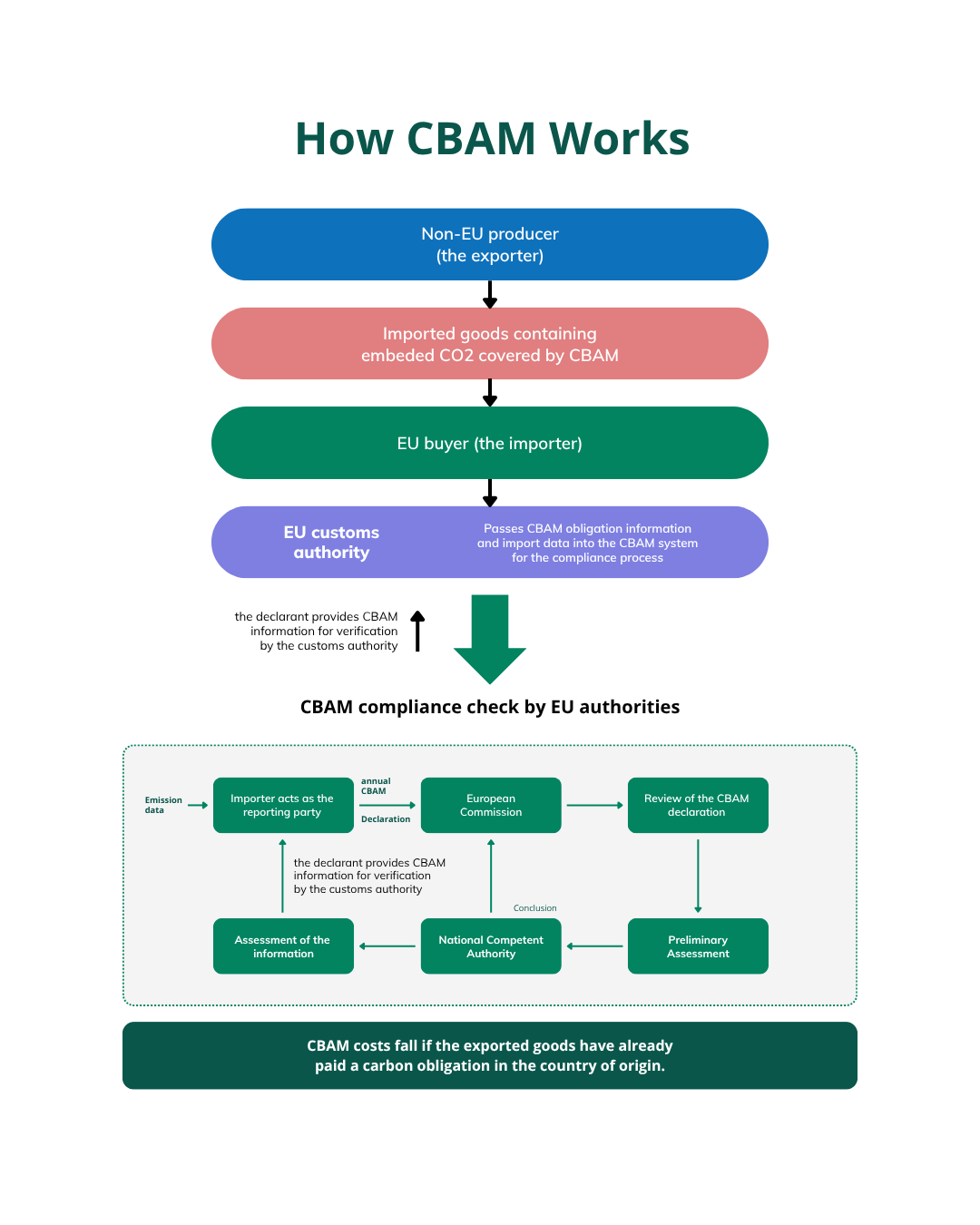
That data then travels through the system shown below. It is filed by the declarant, reviewed, and can be assessed by a national authority with the power to impose penalties. The exporter’s figure ends up in front of parties that have no relationship with the exporter and no reason to give it the benefit of the doubt. The CBAM Registry is the electronic platform behind all of it, and non-EU installation operators can use it to provide their installation and emissions information to declarants directly.
What CBAM Costs, and When
The cost attached to those emissions tracks the EU carbon market. The rules sit in the CBAM Regulation, Regulation (EU) 2023/956, as amended by Regulation (EU) 2025/2083, with the pricing methodology in Regulation (EU) 2025/2548. The Commission sets the certificate price as the weighted average of the auction clearing prices of auctioned EU ETS allowances. It publishes that price quarterly through 2026 and weekly from 2027.
| Quarter | Published | Price per tonne of CO2 |
| Q1 2026 | 7 April 2026 | EUR 75.36 |
| Q2 2026 | 6 July 2026 | EUR 75.28 |
| Q3 2026 | 5 October 2026 | Not yet published |
| Q4 2026 | 4 January 2027 | Not yet published |
These are not fixed CBAM tariffs. The certificate price moves with the European carbon market, while the CBAM adjustment is phased in alongside the gradual phase-out of free EU ETS allowances, from 2.5% in 2026 to full phase-in in 2034. In practical terms, CBAM exposure depends on the product’s embedded emissions, the applicable phase-in factor, and the prevailing certificate price.
The timing also matters. For 2026 imports, certificates become available for purchase from February 2027, while the first annual declaration is due by 30 September 2027. One threshold is worth knowing from the exporter’s side. The Omnibus amendment, Regulation (EU) 2025/2083, in force since October 2025, set a single annual threshold of 50 tonnes of CBAM goods. A buyer importing less than that in a calendar year sits outside the definitive regime altogether, so whether CBAM reaches a given shipment often depends on the size of the buyer rather than the size of the supplier.
One further provision can reduce the amount payable. Article 9 of the CBAM Regulation allows a qualifying carbon price already paid in the country of origin to be taken into account, so the same emissions are not charged twice. Whether Indonesia’s own carbon pricing qualifies is a question in its own right, and a later section takes it on directly.
How much does CBAM cost in total?
Those rules produce a total. Analysis of 2024 EU trade data compiled by CO2-IQ puts approximately EUR 89 billion of EU imports inside CBAM’s scope, carrying an estimated EUR 12 billion in added carbon costs once the mechanism is fully phased in.
That EUR 12 billion is a 2034 figure, not a 2026 one. As a simple illustrative calculation rather than a forecast of 2026 CBAM revenue, 2.5 percent of EUR 12 billion is roughly EUR 300 million. That is our own arithmetic on someone else’s estimate, not a published figure, and it holds prices and volumes constant. Nobody is paying EUR 12 billion yet.
That gap is what makes the next few years the deciding ones. The cost is currently small enough to absorb quietly and large enough later to reprice entire supplier relationships. It is not a fine or a penalty, so no one gets a warning letter. It is a recurring annual cost that lands somewhere along each supply chain, and the supplier who cannot document its emissions is the one with the weakest position when the buyer decides where it lands.
Why Indonesian and Southeast Asian Exporters Are Directly Affected
Two factors largely determine a country’s exposure: how carbon-intensive its production is compared with European producers, and how much of its trade goes to the EU. The World Bank’s Relative CBAM Exposure Index, set out in Box 1.1 and Figure 1.8 of the Bank’s 2024 report on pages 7 and 8, combines both, measuring added certificate costs for exporters against the EU average producer, adjusted for EU export share. Across all relevant sectors it puts Indonesia’s aggregate exposure at 0.0017, higher than Malaysia, Thailand and the Philippines, and lower than Vietnam. This is a measure of relative exposure, not a forecast of what any country will pay.
Vietnam sits at the top of the ASEAN list, and the gap is not close. A January 2026 industry briefing covered by RECCESSARY put EU imports of Vietnamese iron and steel at EUR 2.24 billion in 2024, alongside EUR 324 million in aluminium. Thailand sent roughly EUR 120 million of iron and steel over the same period. That is a ratio of more than eighteen to one between two ASEAN neighbours in a single product category, which is why Vietnamese steel mills have been preparing for CBAM years ahead of most of the region.
Indonesia’s position is different, and the difference is easy to misread. Cement and clinker exports, worth around USD 375 million globally in 2024, drive most of the exposure. What matters inside that total is the mix, not the headline. Industry data reported by CemNet shows Indonesian clinker exports rising 7.9 percent to 7.8 million tonnes over the first nine months of 2024, while finished cement exports fell 23.5 percent to 0.788 million tonnes.
The two numbers move in opposite directions, and that is the finding. Clinker is the carbon-heavy half of cement, the stage where limestone is fired and most of the CO2 is released. Finished cement dilutes that clinker with other materials. So an export basket shifting from cement toward clinker is getting more carbon-intensive per tonne shipped, even as total volumes shrink. Indonesia is exporting less, and what it exports carries more embedded carbon. Under a mechanism that prices embedded carbon, that is the wrong direction.
Does Indonesia’s Own Carbon Pricing Count Under CBAM?
This is the question every Indonesian exporter asks first, and it deserves a direct answer rather than a general one. The short answer is that nothing qualifies automatically.
Indonesia does have carbon pricing. The Nilai Ekonomi Karbon (NEK) scheme is a mandatory, intensity-based emissions trading system launched in early 2023, and IDXCarbon has operated as the national carbon exchange since September 2023 under the supervision of the Financial Services Authority. The carbon tax legislated under Law No. 7/2021 has still not been implemented, and Presidential Regulation 110/2025 positions it to work alongside the ETS rather than replace it.
Participation in an Indonesian carbon market is not by itself proof that a qualifying carbon price has been effectively paid on the emissions embedded in a particular shipment. Article 9 turns on a price actually paid and linked to the declared embedded emissions, supported by evidence and independent certification. How any specific payment is recognised depends on EU rules that were still being written in 2026: in May the European Commission published a draft implementing act on carbon prices paid in third countries for a four-week feedback period, covering proof of payment, currency conversion, and eligibility criteria for third-party certifiers.
There is also a practical point that comes before eligibility. NEK’s current implementation is focused on the power sector. Phase 1 covered coal-fired plants of 25 MW and above connected to the PLN grid. Phase 2, running from 2025 to 2027, added captive coal and gas-fired plants, and Phase 3 from 2028 extends to all fossil fuel plants of 2 MW and above. Expansion to industrial sectors is planned but not yet in force.
None of the four sectors where Indonesia is CBAM-exposed sits inside the scheme today. For most Indonesian cement, steel, aluminium and fertilizer installations, the question is therefore not whether a domestic carbon price would qualify, but whether one has been paid at the installation that produced the goods at all. Until the EU rules are final and the facts of a specific payment are assessed, treat eligibility as an open compliance question rather than a confirmed deduction.
Which Sectors Are Covered, and Why Only Some Apply to Indonesia
Of the six CBAM-covered sectors, Indonesia’s actual export exposure concentrates in four: iron and steel, aluminium, cement, and fertilizer. Electricity and hydrogen carry effectively zero export value from Indonesia to the EU.
The EU-level picture matches that concentration almost exactly. The European Commission published its first operational data in January 2026. Measured by mass in tonnes rather than by value, iron and steel accounted for 98% of CBAM-covered import volumes, followed by fertilizers at 1.2%, cement at 0.5%, and aluminium at 0.3%. Electricity and hydrogen were recorded at 0% in this preliminary snapshot.
Scope is also moving, and it has moved recently. The European Commission proposed extending CBAM to downstream steel and aluminium products in December 2025, and on 12 June 2026 the Council agreed its position on that expansion, which the Commission welcomed the same day. At the end of June 2026 the European Parliament’s environment committee adopted its own position, by 56 votes to 11 with 12 abstentions, backing the expansion and adding tighter anti-circumvention rules (European Parliament). Parliament is expected to adopt its negotiating mandate at the September 2026 plenary, after which trilogue negotiations begin. As of August 2026 the expansion remains under negotiation and forms no part of the CBAM scope that applies today.
As the international law firm Akin Gump Strauss Hauer & Feld has summarised, the Commission’s December 2025 proposal covered roughly 180 downstream product categories from 1 January 2028. They were chosen for combining high carbon leakage risk with high metal content, averaging 79 percent by composition. That figure describes the original proposal rather than adopted law. The list runs to motor vehicles and vehicle components, diesel engines, industrial robots, household appliances, and metal furniture.
That list reaches a different population of companies. It pulls in contract manufacturers, appliance assemblers and automotive component suppliers further down Indonesia’s and Vietnam’s supply chains, companies that have never considered themselves CBAM-relevant because they do not export raw metal.
CBAM Is Now in Operation
CBAM’s transitional phase, which required reporting only and carried no certificate cost, ran from October 2023 through December 2025. The definitive phase, with real certificate costs attached, began on 1 January 2026.
Thousands of EU importers had already secured authorised declarant status before that date. The Commission’s January 2026 implementation update recorded more than 4,100 economic operators holding authorised CBAM declarant status, and 10,483 import customs declarations containing CBAM goods validated automatically between 1 and 6 January, covering 1,655,613 tonnes.
That is an operating system with implementing acts, customs IT infrastructure and enforcement behind it. It is not a proposal still being debated, and the window in which exporters could reasonably treat it as one closed at the end of 2025.
Five Steps to CBAM Readiness for Exporters
- Identify which product lines fall under CBAM. Check your export CN codes against the Commission’s covered goods list, and check the downstream proposal against what you sell if you manufacture further along the chain.
- Define the installation and production-process boundary. CBAM emissions are calculated at that level, so the boundary decision comes before any data collection.
- Collect the underlying plant data. Fuel, electricity, precursor inputs and production volumes, at installation level, for the period your buyer needs. TruCount is built for exactly this kind of installation-level accounting.
- Line up verification early. Only an accredited independent verifier can sign off actual emissions, and that capacity is still being built out. The Commission published updated guidance on CBAM verification and accreditation on 24 August 2026, with the first verification reports expected from January 2027. The documentation habits that survive an audit are the same ones set out in our guide to building a GHG inventory report.
- Send the figures through the CBAM Registry. Registering your installation puts the data in front of your buyer’s declarant in the format they file with, rather than as an attachment.
Ready to Move From Understanding CBAM to Acting on It?
Knowing what CBAM is and why it applies to your sector is the starting point. What determines your actual cost exposure is how prepared your emissions data is when your EU buyer needs it. Two suppliers shipping identical steel can face materially different landed costs, and the difference is documentation, not carbon intensity.
If you want help building the primary emissions data your EU buyers will need, TruCarbon’s climate advisory services can help you get started.
Frequently Asked Questions About CBAM
- What is CBAM in simple terms?
CBAM is a carbon price the EU applies at its border to certain imported goods, calculated on the greenhouse gas emissions released while producing them. It exists so that imported goods carry a carbon cost comparable to what EU producers already pay under the EU Emissions Trading System.
- Which sectors does CBAM cover?
Six: iron and steel, cement, aluminium, fertilizers, electricity, and hydrogen. A December 2025 European Commission proposal would extend coverage to roughly 180 downstream steel and aluminium-intensive products from 1 January 2028, including vehicles and vehicle components, diesel engines, industrial robots, household appliances, and metal furniture. The Council agreed its position on that expansion on 12 June 2026, with further legislative steps still to come.
- Who pays for CBAM, the importer or the exporter?
The legal obligation sits with the EU importer, who must register as an authorised CBAM declarant and buy certificates covering embedded emissions. The commercial cost reaches the exporter anyway. Without verified supplier data, the importer applies EU default values, which are set conservatively, and that difference surfaces in the next price negotiation.
- When did CBAM start charging money?
On 1 January 2026, when the financial obligation began. Emissions embedded in goods imported from that date onwards carry a CBAM cost. Before then, from October 2023 through December 2025, the transitional phase required reporting only, with nothing to buy. Starting to owe is not the same as paying, and the two happen in different years.
- How much does a CBAM certificate cost?
CBAM certificate prices are calculated by the European Commission as the weighted average of EU ETS allowance auction clearing prices, and published on the Commission’s CBAM certificate price page. In 2026 they are published quarterly, in the first calendar week after each quarter closes: EUR 75.36 per tonne of CO2 for Q1 2026, published 7 April 2026, and EUR 75.28 for Q2 2026, published 6 July 2026. From 2027 onwards, the Commission publishes weekly.
- Do importers pay for all of the embedded emissions in 2026?
No. The obligation phases in alongside the withdrawal of free allowances from EU industry, starting at 2.5 percent of embedded emissions in 2026, reaching 48.5 percent in 2030 and 100 percent in 2034. The share payable therefore rises substantially over the phase-in period, though the actual cost of any shipment also depends on its embedded emissions and the certificate price at the time.
- Can we deduct a carbon price we already paid in Indonesia?
That is the intention. Article 9 of the CBAM Regulation allows a carbon price already paid in the country of origin to be deducted, so the same emissions are not charged twice. Two conditions decide whether it works in practice. The price must be a real payment on the emissions embedded in the goods you shipped, and you must be able to evidence it. The detailed EU rules on how a foreign carbon price is recognised were still in draft in mid-2026, so check the adopted text before assuming a specific Indonesian instrument qualifies.
- When does the money actually change hands?
Not on import. Certificates go on sale from 1 February 2027, and the first annual CBAM declaration, covering 2026 imports, is due on 30 September 2027, with certificates surrendered against it. Declarants must hold certificates covering at least half of their cumulative emissions at each quarter end in the meantime. So a 2026 obligation accrues now and settles in late 2027.
- Does CBAM apply to my company if I only export to Bangladesh, Australia or within ASEAN?
Not directly. CBAM applies to goods entering the EU. Two things still make emissions data worth building: the December 2025 downstream proposal would reach manufacturers who never export raw metal to Europe, and buyers in non-EU markets are increasingly asking the same product-level emissions questions.
- Is a corporate carbon footprint enough for CBAM?
No. A corporate carbon footprint covers a whole company for a year and cannot be submitted as a CBAM emissions figure. CBAM embedded emissions are determined at the installation and production-process level under the applicable CBAM methodology, expressed as specific embedded emissions per tonne of product. A conventional product carbon footprint is not a direct substitute either, because its calculation boundary differs from CBAM’s. The same underlying plant data can feed all of them, which is why it is worth building once and building properly.
- What happens if we cannot provide emissions data at all?
The import still proceeds. The importer applies EU default values, which are deliberately conservative, and the resulting cost is higher than a verified figure would produce in most cases. Suppliers who can document their emissions negotiate on their own numbers. Suppliers who cannot get priced on assumptions.