


A procurement officer at a German auto supplier emails your sustainability lead asking for “your carbon footprint.” A retailer asks marketing for “the carbon footprint” to print on packaging. An ESG fund asks your project team how many credits the peatland project will issue this year. Three different requests were calculated under different standards, with different boundaries and different verification rules.
Send the wrong one and you can be disqualified from a tender, fail a regulatory check, trigger a greenwashing complaint under the UK CMA Green Claims Code or the EU Empowering Consumers Directive, or have a credit purchase rejected at due diligence. The three carbon footprint types, product (PCF); corporate (CCF); and project carbon footprint, are not interchangeable.
This guide explains the three carbon footprints, the standards that govern each, when each one applies, and how to avoid sending the wrong figure to the wrong person.
What is the difference between PCF vs CCF vs a project carbon footprint? (short answer)
In one line: a product carbon footprint (PCF) measures one product, a corporate carbon footprint (CCF) measures one company for one year, and a project carbon footprint measures the emissions one project reduces, avoids, or removes against a baseline.
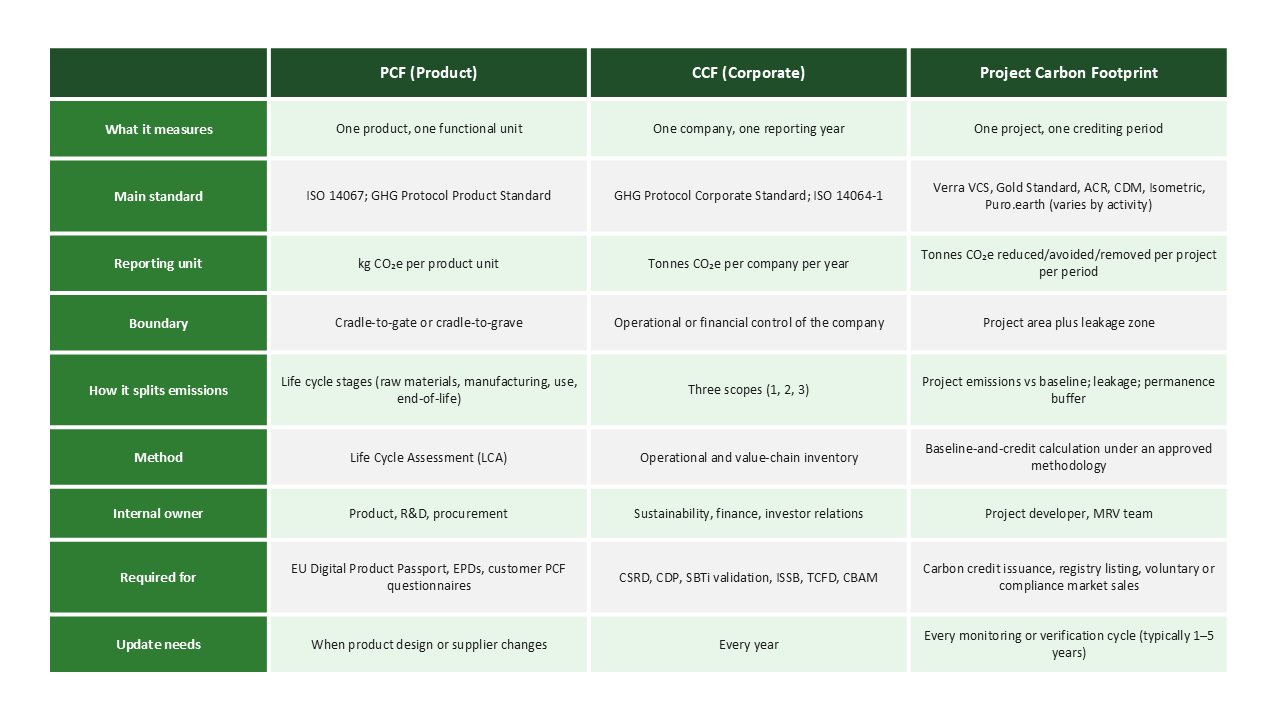
- Product carbon footprint (PCF): Measures the greenhouse gas emissions of one product across its life cycle, from raw material extraction to end-of-life. Governed by ISO 14067 or the GHG Protocol Product Standard. Reported as kg CO₂e per functional unit (per kg of cement, per smartphone, per kWh delivered).
- Corporate carbon footprint (CCF): Measures the greenhouse gas emissions of a whole company over one reporting year. Governed by the GHG Protocol Corporate Standard (and ISO 14064-1), split into Scope 1, Scope 2, and Scope 3. Reported as total tonnes CO₂e per company per year.
- Project carbon footprint: Measures the emissions a specific project reduces, avoids, or removes against a counterfactual baseline. Governed by a Verra, Gold Standard, ACR, CDM, Isometric, or Puro.earth methodology, depending on the activity. Reported as tonnes CO₂e per project per crediting period, and used to issue carbon credits.
Put simply: PCF measures one product. CCF measures one company. A project carbon footprint measures one project.
PCF vs CCF vs project carbon footprint: at-a-glance comparison
The table below summarises how the three carbon footprint types differ across what they measure, the governing standard, the reporting unit, and which team owns each one.
What a product carbon footprint (PCF) actually counts
A PCF is part of a Life Cycle Assessment (LCA), the standardised method for measuring the environmental impacts of a product across its full life. Because the PCF sits inside the LCA framework, it follows the LCA method: break the product’s life into stages, count the emissions of each one, and add them up against a defined functional unit (one kg of cement, one smartphone, one kWh delivered).
The six life cycle stages of a product
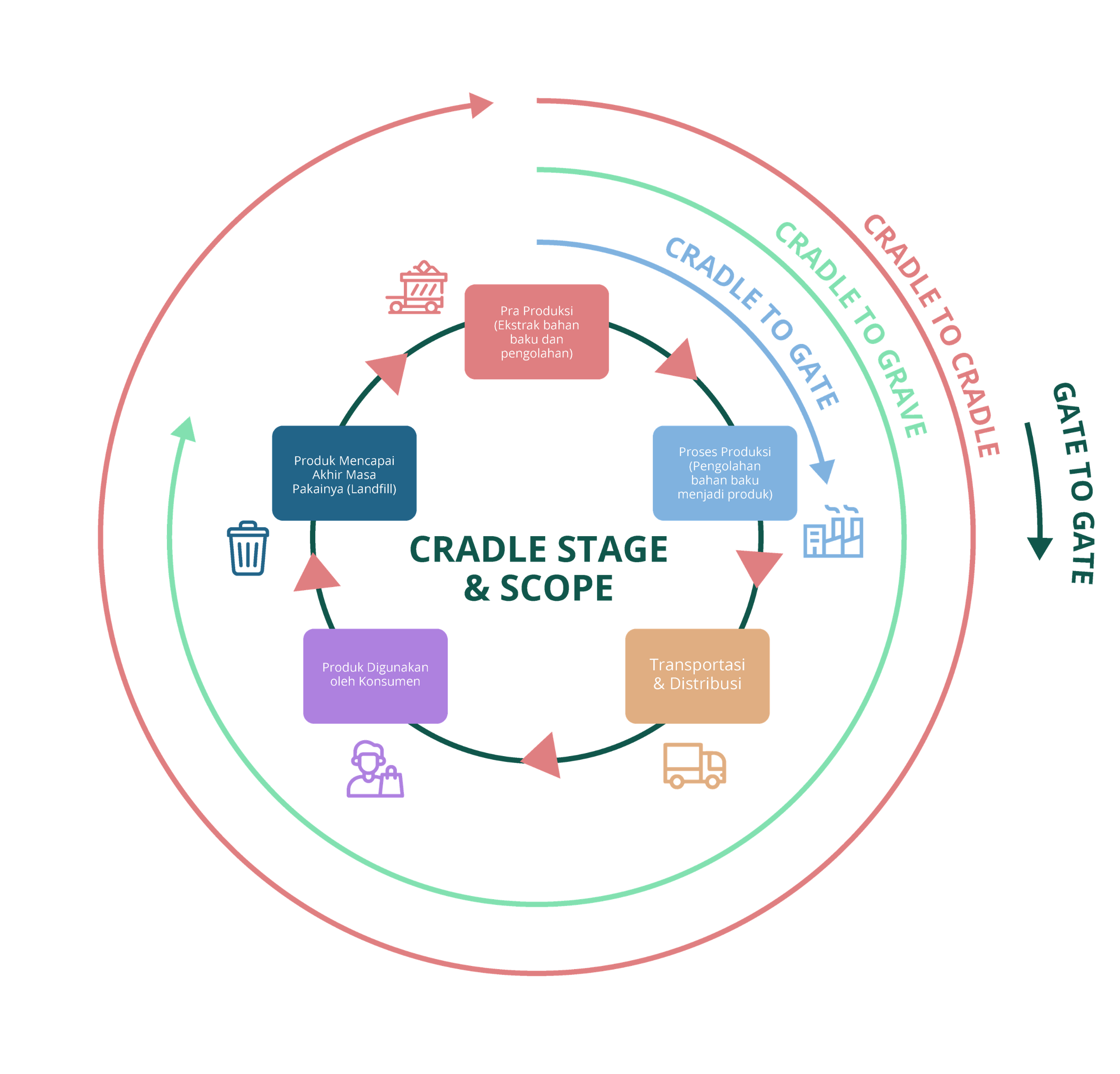
- Raw materials. Extracting and processing inputs — mining iron ore, growing cotton, drilling for crude oil. Includes every supplier upstream of you.
- Inbound transport. Moving raw materials from supplier to factory: trucks, ships, trains, planes.
- Manufacturing. What happens inside your factory — electricity, fuels burned in boilers, and process emissions (chemical reactions that release CO₂, common in cement and steel).
- Outbound transport and distribution. Finished product to the warehouse, retailer, or buyer. Includes packaging.
- Use phase. What the customer does with the product — appliance electricity over its lifetime, car fuel, hot water during a shampoo rinse.
- End-of-life. Disposal pathway: recycling, landfill, incineration, or composting. Each has different emissions.
Cradle-to-gate vs cradle-to-grave: the boundary choices
The system boundary decides which of the six stages you count. There are four common choices.
- Cradle-to-gate. Stages 1 to 3 only, ending at your factory gate. Common for B2B intermediate goods like steel, cement, or specialty chemicals, where the buyer keeps processing the material.
- Cradle-to-grave. All six stages. Required for consumer-facing claims, for the EU Digital Product Passport, and for any “footprint of one finished product” claim aimed at end users.
- Cradle-to-cradle. Counts the product beyond its own life by adding credit for materials recycled into new products. Less standardised, used mainly in design and circularity contexts.
- Gate-to-gate. Stage 3 only (manufacturing inside your facility). Useful internally to compare two factories, but rarely accepted by external buyers because it ignores supplier emissions, which are usually the largest share.
What standards govern a PCF: ISO 14067 vs GHG Protocol Product Standard
ISO 14067 is the dominant international standard. Built on ISO 14040 and 14044, it specifies which gases to include, how to split emissions between two products made in the same process (allocation), how to treat carbon stored in wood or crops (biogenic carbon), and how a third party verifies the result.
The GHG Protocol Product Standard is the other widely used standard. It covers similar ground and is often referenced in parallel.
A complete PCF for a complex manufactured product takes three to nine months. The slowest part is rarely the calculation — it is collecting primary data from upstream suppliers, especially when those suppliers are doing this for the first time.
In our work with Indonesian manufacturers at TruCarbon, this is where most PCF projects stall. Tier-1 suppliers sell directly to your factory; Tier-2 are the suppliers of your Tier-1 suppliers; Tier-3 sit one step further upstream, typically raw-material producers and primary processors. These deeper tiers rarely keep emissions data in a form that drops into an LCA model, so the engagement becomes part calculation, part supplier capacity-building.
What a corporate carbon footprint (CCF) actually counts
A CCF is a company-wide inventory of greenhouse gas emissions over one reporting year. The GHG Protocol Corporate Standard splits it into three scopes.
- Scope 1 — direct emissions. Anything burned or leaked on assets the company owns or controls: natural gas in a factory boiler, refrigerant leaks from HVAC systems, fuel in fleet vehicles. If you can put your hand on the source, it is probably Scope 1.
- Scope 2 — purchased energy. Electricity, steam, heat, or cooling bought from a utility. Reported under two methods in parallel: location-based (the average grid your facility sits on) and market-based (the specific contracts and certificates you procured).
- Scope 3 — everything else in the value chain. Fifteen categories, from purchased goods and services (Category 1) to use of sold products (Category 11) and end-of-life treatment of sold products (Category 12). For most manufacturers and retailers, Scope 3 is the largest share of the inventory, typically 70 to 90% of total emissions. CDP’s 2024 Supply Chain Report (“Strengthening the Chain”) found that disclosing companies’ Scope 3 supply-chain emissions averaged 26 times their Scope 1 + 2 operational emissions.
What standards govern a CCF: GHG Protocol vs ISO 14064-1
The GHG Protocol Corporate Standard is the dominant international standard. It defines the three-scope structure, sets the rules for choosing between operational control and financial control as a consolidation boundary, and specifies how Scope 1 and 2 are reported. Two companion standards extend it: the GHG Protocol Scope 2 Guidance (2015), which requires dual reporting (location-based and market-based) for purchased electricity, steam, heat, and cooling; and the GHG Protocol Corporate Value Chain (Scope 3) Standard, which governs the fifteen Scope 3 categories.
ISO 14064-1 is the ISO equivalent. Closely aligned with the GHG Protocol but with different terminology (it speaks of direct and indirect emission categories rather than Scopes 2 and 3). Most companies report against both to satisfy auditors, regulators, and value-chain partners who reference different conventions. ISO 14064-3 is the companion verification standard used by third-party assurance providers.
A CCF prepared under these standards feeds the major disclosure frameworks: CSRD (ESRS E1), IFRS S1 & S2 (ISSB), CDP, and SBTi. CBAM, in its definitive period since January 2026, draws on corporate-level data disaggregated to individual goods. Each framework adds its own disclosure or target requirements, but the inventory itself is built once.
A CCF is updated annually. It is never finished, because Scope 3 estimates keep improving as supplier-specific data replaces industry averages. Purpose-built carbon accounting software like TruCount is what keeps a multi-entity inventory audit-ready year after year.
What a project carbon footprint actually counts
A project carbon footprint measures the emissions a specific project reduces, avoids, or removes compared to a baseline scenario (what would have happened without the project). The difference becomes the basis for carbon credit issuance.
This is the footprint behind every voluntary or compliance market credit. A peatland restoration project in Riau, a biochar facility in Java, a mangrove conservation project in Kalimantan, an avoided-deforestation REDD+ project in Sumatra: each produces a project carbon footprint that registries audit before issuing credits.
The four building blocks of a project carbon footprint
- Baseline. The emissions that would have occurred without the project. For a peatland project, that is the CO₂ released by ongoing drainage and fires; for a renewable energy project, it is the grid electricity displaced. The baseline is the counterfactual, and its credibility determines the credibility of the credits.
- Project emissions. The emissions caused by the project itself — diesel burned by monitoring vehicles, fertiliser used in reforestation, and methane released during wetland refill. Subtracted from the baseline.
- Leakage. Emissions that shift outside the project boundary because of the project. If protecting one forest pushes logging into a neighbouring forest, that is leakage and must be deducted.
- Permanence buffer. A percentage of credits set aside in a registry-managed pool to cover the risk that stored carbon is released later (a fire, a policy reversal, a tenure dispute). Required for most nature-based projects.
Net credits = baseline emissions − project emissions − leakage − permanence-buffer contribution.
What methodologies govern a project carbon footprint
There is no single standard. A carbon registry is the platform that issues, tracks, retires, and publicly records carbon credits under a defined rulebook — think of it as the stock exchange of the carbon market, where each “listing” must follow an approved methodology. Each registry maintains its own library of methodologies tied to specific project activities. The most common in Indonesia and Southeast Asia:
- Verra VCS. The largest voluntary registry. Methodologies commonly used in Indonesia include VM0007 (the historic REDD+ framework for forest and peatland projects, now transitioning to VM0048 for unplanned deforestation components), VM0033 (tidal wetland and seagrass restoration, applied to mangrove projects), VM0047 (afforestation, reforestation, and revegetation, or ARR), and VM0048 (the newer REDD methodology for unplanned deforestation, launched November 2023). Each methodology defines its own baseline rules, monitoring requirements, and leakage factors.
- Gold Standard. Common for renewable energy and community-based projects.
- ACR (American Carbon Registry) and CAR (Climate Action Reserve). US-focused registries used internationally for selected methodologies.
- CDM (Clean Development Mechanism). The UN-administered standard from the Kyoto era, now transitioning to the Article 6.4 mechanism under the Paris Agreement.
- Isometric and Puro.earth. Newer registries focused on engineered carbon removals (biochar, enhanced weathering, direct air capture, BECCS).
- National standards. In Indonesia, projects are registered on SRN-PPI (Sistem Registri Nasional Pengendalian Perubahan Iklim, the national climate-change registry) and can be certified under SPEI (Sertifikasi Pengurangan Emisi GRK Indonesia), producing SPE-GRK certificates listed on the IDXCarbon trading platform. Methodologies are approved by the Ministry of Environment / BPLH (Kementerian Lingkungan Hidup / Badan Pengendalian Lingkungan Hidup, KLH/BPLH), together with the new Ministry of Forestry (Kementerian Kehutanan). In October 2025, SRN-PPI also signed mutual-recognition agreements with Verra, Gold Standard, Global Carbon Council, and Plan Vivo.
How a project carbon footprint is verified
Every project carbon footprint goes through three stages before credits are issued.
- Validation. A third-party auditor (Verra calls them VVBs, Validation/Verification Bodies) reviews the project design document and confirms it meets the methodology.
- Monitoring. The project developer collects field data (water tables, biomass, satellite imagery, fuel use) over a defined monitoring period, usually one to five years.
- Verification. A separate audit confirms that the monitored data is accurate and the credit calculation is correct. Credits are then issued on the registry.
The first full cycle for a nature-based project typically takes 18 to 36 months; subsequent verification rounds are shorter. Digital MRV, like TruMRV, is what shortens monitoring and keeps a multi-year crediting pipeline verification-ready.
Who needs a project carbon footprint
- Project developers (forestry, peatland, biochar, renewable energy, methane abatement) who want to issue and sell credits.
- Investors and credit buyers are doing due diligence on a project before purchase. The methodology, baseline, and monitoring data are the documents that determine credit quality.
- Compliance entities subject to mandatory carbon markets (Indonesia’s IDXCarbon, the EU ETS for offset eligibility, Article 6 ITMO transfers).
- Companies retiring credits to offset emissions counted in their CCF. The project carbon footprint is the source of those credits.
Why a PCF vs CCF vs project footprint don’t reconcile
When teams try to combine a PCF, a CCF, and a project carbon footprint, the totals don’t match. Three reasons explain the gap.
- Boundary differences. A cradle-to-grave PCF includes use-phase emissions of products you sold. A CCF reports your own operations and value chain. A project carbon footprint sits outside both: it measures avoidance against a baseline, not absolute company or product emissions.
- Allocation differences. A factory making three products allocates its emissions across the three under a PCF. The same factory reports the total under Scope 1 and 2 of its CCF, with no product-level split. A project carbon footprint allocates nothing — it measures the project against its counterfactual.
- Different accounting logic. PCF and CCF are inventory accounting (how much was emitted). Project carbon footprints are baseline-and-credit accounting (how much was avoided or removed compared to a scenario that never happened). A company can have a large CCF and own credits from a project carbon footprint at the same time. The credits offset reported emissions only when explicitly retired against the inventory.
The three describe different cuts of climate impact. They are complementary. None substitutes for another.
Which carbon footprint do you need? PCF vs CCF vs project, by role
Marketing — you need a PCF. To put a carbon claim on a label, an ad, or a single-product sustainability page (for example, “30% lower carbon footprint than the previous generation”), you need product-level evidence. The UK CMA Green Claims Code requires it today, and the EU’s Empowering Consumers for the Green Transition Directive (which applies from 27 September 2026) tightens substantiation rules across the EU. A CCF cannot substantiate a claim about a single SKU.
Product / R&D — you need a PCF. To compare design options (which packaging is lower carbon, which steel supplier is cleaner, what the use-phase energy of two motor designs adds up to over ten years), the PCF is the only tool that gives you SKU-level decision data.
Procurement — it depends who is asking. A customer’s PCF questionnaire (now standard in automotive Tier 1, electronics, food and beverage, and increasingly in pharma packaging) wants a PCF for the specific SKU you are quoting. A customer’s Scope 3 disclosure ask, common in consumer goods and apparel, wants either your CCF or the Scope 1 and 2 of the producing facilities, mapped to the goods they buy.
Investor relations, sustainability, compliance — you need a CCF. CSRD, CDP, ISSB, TCFD, and SBTi all require organisation-level inventories. A PCF will not satisfy a CDP scorer or a CSRD limited-assurance auditor.
EU Digital Product Passport — you need a PCF. Under the EU Battery Regulation 2023/1542, EV batteries must carry a third-party-verified carbon-footprint declaration; the start date is tied to the European Commission’s delegated act on the calculation method and has slipped from the original 18 February 2025 target, with compliance now expected once that methodology is finalised (manufacturers get roughly 12 months from publication — verify the current date against the latest delegated act). Industrial batteries, textiles, consumer electronics, and other categories follow under the Ecodesign for Sustainable Products Regulation (ESPR). A CCF will not meet any of these requirements.
Carbon project developer — you need a project carbon footprint. If you are building a peatland, mangrove, ARR, biochar, or renewable energy project, you need a project carbon footprint under the appropriate methodology. Without it, you cannot issue credits.
Carbon credit buyer or investor — read the project carbon footprint first. Before signing, read the project carbon footprint behind the credits. The methodology, baseline assumptions, leakage deductions, and monitoring data are the documents that tell you whether the credit is credible.
Offsetting CCF emissions with credits — you need both. The CCF tells you what to offset; the project carbon footprint tells you what the credits are actually worth.
For Indonesian exporters specifically, the request is increasingly bilingual: a European buyer wants ISO 14067-aligned PCFs in English, the production team operates in Bahasa Indonesia, and the data sits between the two. This is the gap TruCarbon solves, most often in CBAM-exposed sectors (cement, steel, aluminium, fertiliser) and in apparel and FMCG suppliers serving EU brands. On the project side, we see Indonesian developers building peatland, mangrove, and biochar projects that need to clear due diligence from European, Japanese, and Korean buyers.
Three questions to ask before producing any carbon footprint
Before your team commits to any of the three footprints, get clarity on these three things.
- Who is asking, and what decision will the footprint drive?
A buyer is making a procurement decision. A regulator is checking compliance. An investor is benchmarking risk or evaluating credit quality. The use case dictates the standard, the scope, and the verification level. - What is the boundary?
Cradle-to-gate is enough for a B2B intermediate input; cradle-to-grave is required for consumer claims and the EU DPP. For a CCF, the boundary is operational or financial control, and the choice changes which entities are consolidated. For a project carbon footprint, the boundary is the project area plus the leakage zone defined by the methodology. - Does it need verification, and against what standard?
ISO 14067 PCFs are typically verified by an LCA-accredited body. CSRD-reported CCFs require limited assurance from a third-party auditor today, with reasonable assurance on the timeline. Project carbon footprints require validation and verification by an accredited VVB before credits are issued. The verification cost can exceed the calculation cost, so knowing the answer upfront avoids redoing the work.
If the request is vague, push back before starting. “Your carbon footprint” is not a specification.
The takeaway for marketing, product, procurement, and project teams
When someone asks for “your carbon footprint,” ask back: per product, per company, or per project? For which market, against which standard, and verified to what level?
A PCF tells you what one unit of what you sell costs the climate. A CCF tells you what your business costs the climate. A project carbon footprint tells you what one project avoids or removes against a baseline.
If you are starting from zero, the practical order is usually: CCF first (regulators and investors ask for it sooner), then PCFs for your highest-revenue or highest-emission SKUs, then a system that keeps both updated annually. If you are also a project developer or credit buyer, a project carbon footprint runs on a separate track, governed by its own methodology and registry.
How TruCarbon can help
TruCarbon builds all three footprints for companies operating in or exporting from Indonesia and the wider region, under GHG Protocol, ISO 14064-1, ISO 14067, Verra VCS, Gold Standard, Isometric, Puro.earth, and the EU-facing frameworks (CSRD/ESRS E1, CBAM, EU Battery Regulation) referenced throughout this article. Explore TruCount carbon accounting software, TruMRV for project verification, or our climate advisory and carbon project development services.
If you are not sure which one you need, or if the request from your buyer, regulator, investor, or project counterparty is still vague, that is the conversation we start with. Tell us who is asking, what market the footprint is for, and the level of verification expected. We come back with the right standard, boundary, and timeline before any calculation begins, so you do not pay to redo work scoped against the wrong specification.
Talk to us: contact us here, email [email protected], or message us on WhatsApp.
Frequently asked questions
- What do PCF, CCF, and CF stand for in carbon accounting?
PCF is a product carbon footprint (the emissions of one product across its life cycle, in kg CO₂e per unit). CCF is a corporate carbon footprint (a whole company’s emissions for one year, in tonnes CO₂e, split into Scope 1, 2, and 3). A project carbon footprint measures the emissions one project reduces, avoids, or removes against a baseline, and is the basis for issuing carbon credits.
- Is a product carbon footprint the same as a life cycle assessment?
No. An LCA covers multiple environmental impacts (climate, water, eutrophication, land use, acidification). A PCF is the climate slice of an LCA, expressed in kg CO₂e.
- Can a corporate carbon footprint be used for a product-level marketing claim?
No. A CCF cannot substantiate a claim about a specific product. The UK CMA Green Claims Code already requires product-level evidence for product-level claims, and the EU’s Empowering Consumers for the Green Transition Directive applies the same expectation across the EU from 27 September 2026. (The separate EU Green Claims Directive was withdrawn by the European Commission in June 2025.)
- Does Scope 3 in my CCF replace the need for PCFs?
No. Scope 3 Category 1 (purchased goods and services) is most often estimated using spend-based or industry-average emission factors. Supplier-specific PCFs are the higher-accuracy alternative, and what mature reporters are migrating toward.
- Is CBAM a PCF or a CCF requirement?
Both, depending on the role. The EU importer reports embedded emissions of specific goods (a PCF-style number). The producer needs primary production-level data, which usually comes from the CCF system and is then disaggregated per product. CBAM entered its definitive period on 1 January 2026.
- What is the difference between a project carbon footprint and a corporate carbon footprint?
A project carbon footprint measures emissions reduced, avoided, or removed by one specific project, calculated against a baseline, and it produces carbon credits. A CCF measures total company emissions for one year across Scope 1, 2, and 3. It is a disclosure document, not a credit-issuance document.
- Can I use a project carbon footprint to substantiate a marketing claim?
Not directly. Credits issued from a project carbon footprint can offset emissions reported in your CCF, but a “carbon neutral” or similar product claim still requires a PCF for the product itself, plus credible offset accounting.
- Which methodology should a project developer in Indonesia choose?
For tropical peatland and wetland projects, VM0007 (transitioning to VM0048 for unplanned-deforestation components); VM0036 covers temperate-zone peatland rewetting and is not typically applicable in Indonesia. For mangrove restoration, VM0033. For afforestation and reforestation, VM0047. For unplanned deforestation, VM0048. For biochar, Verra VM0044, Puro.earth, or Isometric. For domestic compliance, methodologies approved under SPEI and listed on IDXCarbon. The right choice depends on the project activity, the destination market for the credits, and the buyer’s preference.
- Which carbon footprint takes the longest and costs the most to produce?
A single complex PCF (cradle-to-grave, primary supplier data, third-party verified) costs more per number than the first year of a CCF. A project carbon footprint typically costs more than a single PCF, because validation and verification cycles run longer and require ongoing monitoring (a first nature-based cycle is usually 18–36 months). A full PCF programme across a product portfolio, or a multi-project credit pipeline, almost always exceeds the cost of a CCF programme.
- Which standards does TruCarbon use for Indonesian clients?
For corporate footprints: GHG Protocol Corporate Standard and ISO 14064-1, aligned with GRI, SBTi, CDP, and IFRS S1 & S2. For product footprints: ISO 14067 or the GHG Protocol Product Standard, depending on the destination market and the customer’s procurement requirement. For project carbon footprints: Verra VCS methodologies (VM0007, VM0033, VM0047, VM0048, with VM0044 for biochar), with selected projects also engaging Gold Standard, Isometric, or Puro.earth depending on the activity.
Quick glossary
Reference terms used throughout this article. For the full list, see the TruCarbon climate glossary.
- SKU (Stock Keeping Unit): A specific product variant — one bottle size, one flavour, one trim level.
- Functional unit: The defined “one unit” a PCF is measured against (per 1 kg of cement, per smartphone, per 1 kWh delivered).
- LCA (Life Cycle Assessment): The standardised method of measuring environmental impacts of a product across its full life.
- EPD (Environmental Product Declaration): A verified, published summary of an LCA. Common in construction materials.
- Cradle-to-gate, cradle-to-grave, gate-to-gate: The boundary choices for a product footprint.
- Scope 1, Scope 2, Scope 3: The three categories of corporate emissions defined by the GHG Protocol.
- Baseline: The counterfactual emissions scenario a project carbon footprint is measured against.
- Leakage: Emissions that shift outside the project boundary because of the project.
- Permanence buffer: A pool of credits set aside to cover the risk that stored carbon is released later.
- VVB (Validation/Verification Body): The third-party auditor that validates a project design and verifies issued credits.
- Methodology: The registry-approved rulebook a project carbon footprint follows (for example, Verra VM0047 for afforestation).
- Crediting period: The defined timeframe over which a project can issue credits (commonly 5, 10, or 30 years, depending on methodology).
- CSRD: EU Corporate Sustainability Reporting Directive.
- CBAM: EU Carbon Border Adjustment Mechanism.
- SBTi (Science Based Targets initiative): A body that validates company climate targets against climate science.
- CDP: An environmental disclosure platform used by investors and large buyers.