


| In Short
An audit-ready GHG Inventory Report is not the same as merely a complete one. Learning how to build a GHG Inventory Report that stands up against a VVB (validation and verification body) audit means writing the Inventory Management Plan (the GHG Protocol’s documented record of how the inventory is built) before you collect a single data point, applying one consolidation approach across every entity, dual-reporting Scope 2 whether or not you buy renewable energy certificates, and keeping a reconciliation trail verifiers can actually follow. The eight steps below reflect what the GHG Protocol Corporate Standard requires, not what most first-time reporters assume. |
| What’s changing in 2026-2027 for GHG Protocol
The GHG Protocol is mid-revision. A Technical Working Group has been reworking the Scope 3 Standard since 2024; a Phase 1 progress update dated 31 March 2026 proposes changes including a 95% coverage threshold for required Scope 3 emissions and stronger data-quality and verification-disclosure rules. Under a September 2025 ISO-GHG Protocol partnership, ISO experts joined the working groups from Q1 2026 to align ISO 14064 and the GHG Protocol. A full public-consultation draft is still to come, and timelines keep moving, so verify against ghgprotocol.org before relying on any date. |
The Inventory Verifiers Accept Is Not the One You Built to Understand Your Footprint
Building a GHG Inventory Report and having one that stands up against a VVB audit are two different achievements, and the gap between them is where most companies get caught off guard. Most sustainability teams build their first inventory to understand their own footprint, not anticipating that a verifier will eventually ask for the documentation behind every number, every emission factor choice, and every excluded facility. Fixing an inventory after a verifier flags it costs more time and credibility than building it right from the start.
Understanding how to build a GHG Inventory Report that is genuinely audit-ready means treating documentation, not calculation, as the hardest part of the work. This article walks through what to do, in what order, and against which standard, before that first external review lands on your desk.
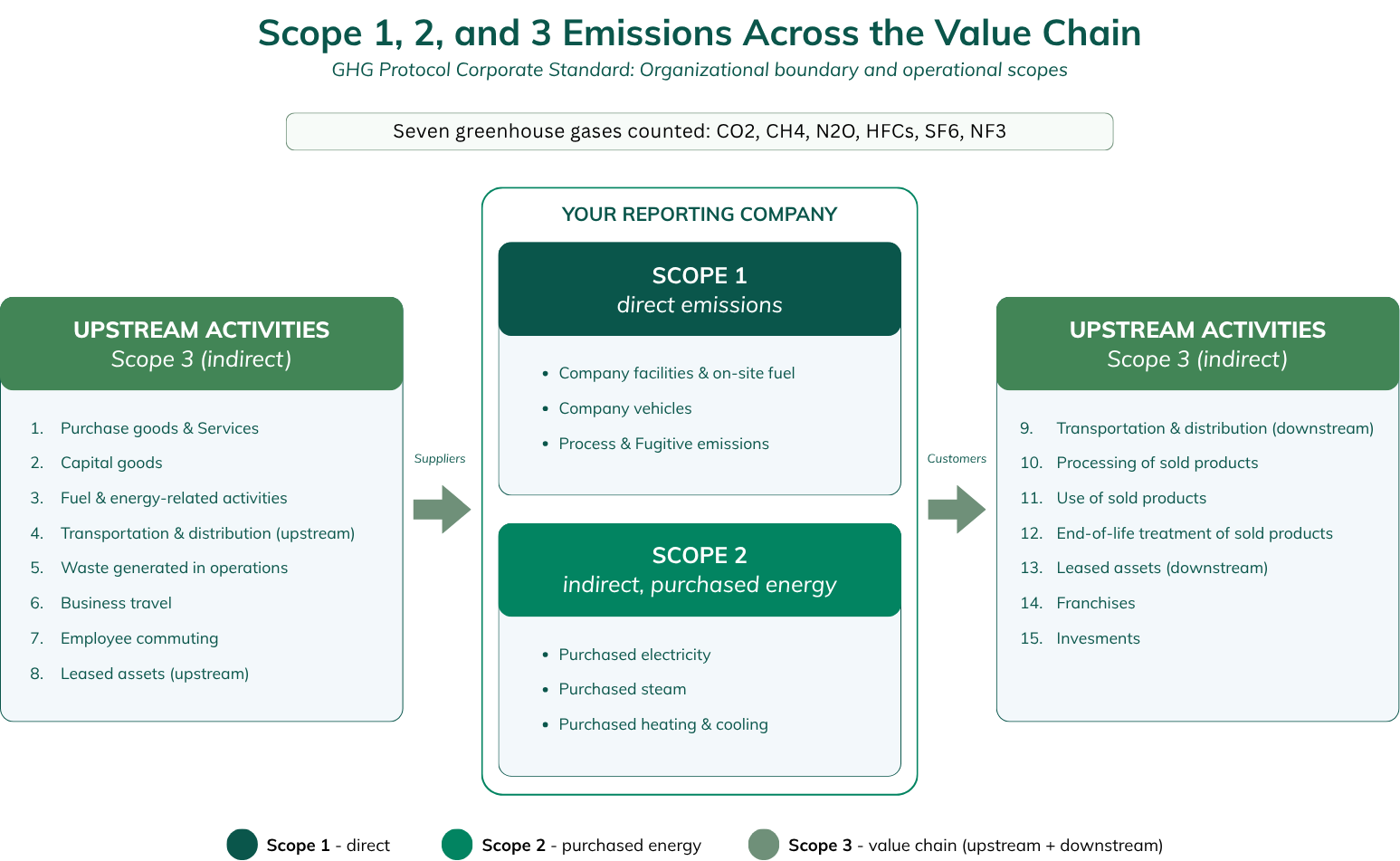
What “Audit-Ready” Means Under the GHG Protocol Corporate Standard
Before covering how to build a GHG Inventory Report step by step, it helps to define what verifiers actually check against. The GHG Protocol Corporate Accounting and Reporting Standard, first published by the World Resources Institute and the World Business Council for Sustainable Development in 2001 and revised in 2004, sets five reporting principles that function as audit criteria, namely relevance, completeness, consistency, transparency, and accuracy. These are not aspirational values. They are the framework external verifiers use to accept or reject your figures.
Chapter 7 of the Corporate Standard, titled Managing Inventory Quality, sets out how to build an inventory quality management system. The Inventory Management Plan (IMP) that has grown out of that guidance is the documented, evolving record of how the inventory is built and maintained, and it is one of the first documents a verifier asks to see. A GHG Inventory Report can be numerically correct and still fail review if the documentation behind it does not exist.
In practice, an audit-ready GHG Inventory Report has three qualities:
- The organizational boundary is documented and justified.
- Every figure can be traced back to a primary source document.
- The methodology behind each number is written down before the data is collected, not reconstructed afterwards.
How to Build A GHG Inventory Report: The 8-Step Audit-Ready Framework
The eight steps below cover how to build a GHG Inventory Report in the sequence an external verifier will review it. Each step maps to a specific decision or requirement in the GHG Protocol Corporate Standard or its 2015 Scope 2 Guidance.
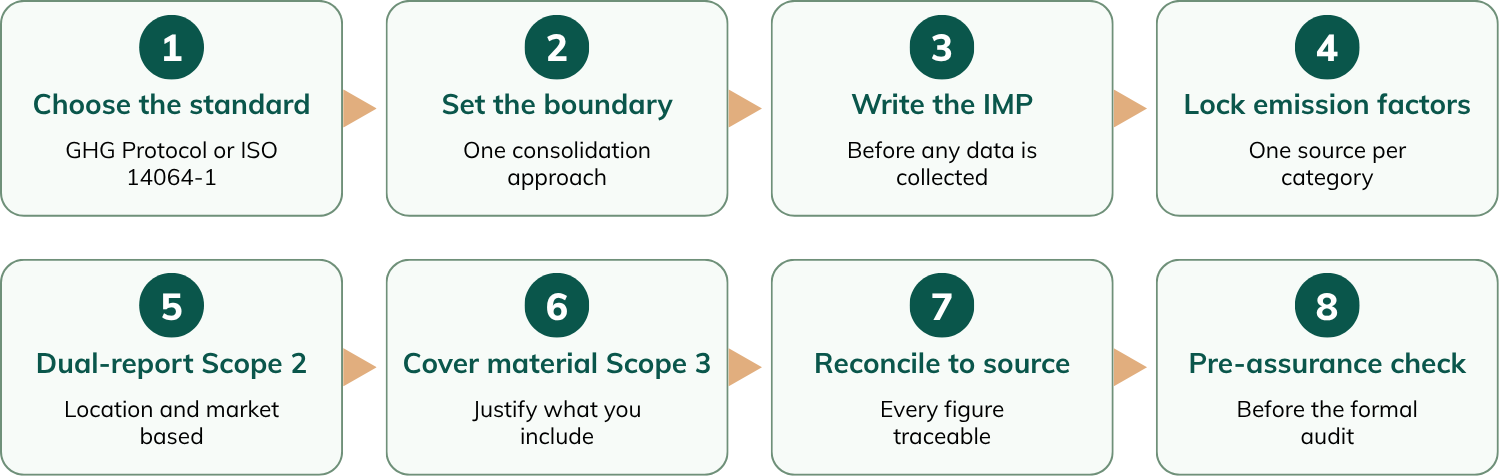
Step 1: Choose the GHG Accounting Standard That Fits Your Reporting Obligation
Choosing the right standard means matching the inventory to your reporting obligation. Build on the GHG Protocol Corporate Standard for company-level Scope 1, 2, and 3 accounting, and add ISO 14064-1 conformity when you need a certifiable standard.
Before any boundary or data decision, decide which standard you are building the inventory against, because the standard sets the rules a verifier will hold you to. These standards in common use are not rivals you pick between. They are complementary and designed to be used together.
- GHG Protocol Corporate Standard
The GHG Protocol Corporate Accounting and Reporting Standard is the methodology layer, the “how.” It is the global default for company-level Scope 1, 2, and 3 accounting and provides the detailed guidance and calculation tools you actually build the inventory with. Use it when your inventory feeds voluntary disclosure such as CDP or SBTi, or mandatory climate reporting.
- ISO 14064-1
ISO 14064-1:2018 is the specification layer, the “what.” It sets out the requirements a GHG Inventory Report and its report must meet, and it is certifiable: a verification body can audit an inventory against it through a formal ISO conformity assessment, which buyers, tenders, or regulators sometimes ask for.
The 2007 memorandum between ISO and the GHG Protocol’s authors (WRI and WBCSD) put the relationship plainly: ISO 14064 sets the requirements, the “what,” while the GHG Protocol provides the methodology, the “how,” and the two are designed to be used in a complementary manner. Because ISO 14064-1 sorts emissions into direct and indirect categories that map onto the Scope 1, 2, and 3 model, it fits alongside the GHG Protocol rather than replacing it.
| Standard | Type | What it does | When to use it |
| GHG Protocol Corporate Standard | Methodology (the “how”) | Provides the methods, guidance, and calculation tools to quantify Scope 1, 2, and 3 emissions | Global default for company-level Scope 1, 2, and 3 accounting |
| ISO 14064-1:2018 | Specification (the “what”) | Sets the requirements a GHG Inventory Report and report must meet; certifiable against ISO conformity | When a buyer, tender, or regulator asks for ISO conformity |
Step 2: Set Your Organizational Boundary Before You Collect a Single Number
The organizational boundary defines which entities and facilities sit inside the inventory. The GHG Protocol Corporate Standard offers three approaches, equity share, financial control, and operational control, and requires one to be applied consistently across every subsidiary, joint venture, and leased facility. With the standard chosen, this boundary decision, not which data to collect, is the next thing to settle.
What is an organizational boundary?
An organizational boundary defines which entities and facilities a company includes in its GHG Inventory Report. It is set by applying one consolidation approach, equity share, financial control, or operational control, consistently across every subsidiary, joint venture, and leased asset.
The GHG Protocol Corporate Standard offers three organizational boundary approaches, namely equity share, financial control, and operational control. Pick one. Apply it consistently at every level of the organization, and document the rationale in your Inventory Management Plan.
Verifiers expect the same approach across all subsidiaries, joint ventures, and leased facilities. Mixing approaches inside one reporting boundary is one of the most common reasons an inventory fails its first verification review.
Document the rationale for every exclusion. An external verifier expects any excluded source, subsidiary, or facility to be explicitly justified, whether the reason is materiality, data unavailability, or the entity falling outside the chosen boundary approach. “We did not include it” is not an audit-defensible answer. “We applied operational control and this joint venture is under our partner’s operational control, per the shareholder agreement dated 14 March 2023” is.
Boundary setting also determines which Scope 3 categories become material later on, so getting Step 2 right saves rework across every downstream step of how to build a GHG Inventory Report correctly.
Step 3: Write Your Inventory Management Plan First
What is an Inventory Management Plan?
An Inventory Management Plan (IMP) is the documented, evolving record of how a company builds and maintains its GHG Inventory Report: the boundary, the data sources, the emission factors, the base year, and the roles behind each figure. It is one of the first documents a verifier asks to see, because it is what makes the inventory repeatable and auditable.
The Inventory Management Plan is the single most underused document in corporate carbon accounting. It is also the first document a good verifier will ask to see.
Anyone building a GHG Inventory Report that will stand up against a VVB audit writes the IMP before collecting a single data point. The commonly cited IMP structure has several components. The three most commonly missed, and the focus here, are data management, base year approach, and management tools, which together tell the verifier how the inventory was constructed and how it will be maintained.
Data Management
Document the sources of activity data for each emission source, and the process for collecting and cleansing that data from its original source to final entry. A utility bill sitting in an email attachment is not activity data. A utility bill logged with an invoice number, a meter reading, a date range, and a responsible owner is.
Base Year Approach
Specify how base-year emissions will be recalculated if structural changes occur, such as mergers, acquisitions, divestitures, or methodology changes. The GHG Protocol Corporate Standard requires companies to disclose the significance threshold used and the recalculation policy. Setting this in advance prevents the awkward discussion of whether to restate history after the fact.
Management Tools
Define roles and responsibilities for inventory development and maintenance, including who is trained to do what. An inventory owned by one person who leaves the company mid-cycle is a governance red flag before it is a data red flag.
Management tools now include dedicated carbon accounting software, not only spreadsheets. TruCount, TruCarbon’s carbon accounting platform, automates activity-data collection and calculation, consolidates parent and subsidiary entities into a single inventory, and generates downloadable reports for disclosure. It also lets a validation and verification body run its audit inside the platform, so the evidence trail the verifier needs sits with the numbers instead of in scattered files.
For completeness, the IMP structure commonly cited in practice has seven components which are organisation information, boundary conditions, emissions quantification methods, data management, the base year and recalculation policy, management tools and roles, and auditing and verification. The three covered above, data management, base year, and management tools, are simply the ones first-time reporters most often leave out.
Step 4: Lock In One Emission Factor Source Per Category
Emission factor consistency means using one documented source per emission category and recording its version and publication year. Verifiers compare figures year on year and expect every change in a factor to be explained in the Inventory Management Plan, not simply reflected in a different number.
Emission factor consistency is where a technically correct GHG Inventory Report quietly loses credibility. When you are building an inventory that reconciles year over year, stick with one emission factor source per category and document the version and publication year.
Verifiers compare year-on-year figures and expect changes to be explained, not merely reflected in different numbers. If you switch from an IEA emission factor to a national grid factor between reporting years, the variance in your Scope 2 figure will be flagged unless the change is documented in the IMP.
Prepare a year-on-year variance analysis that separates how much of any change came from structural change, methodology change, emission factor refresh, and actual emissions change. This is standard audit-ready practice, not extra work. Most first-time reporters skip it and end up reconstructing the analysis under time pressure during the verification round.
Step 5: Fix the Scope 2 Dual Reporting Gap Most Companies Miss
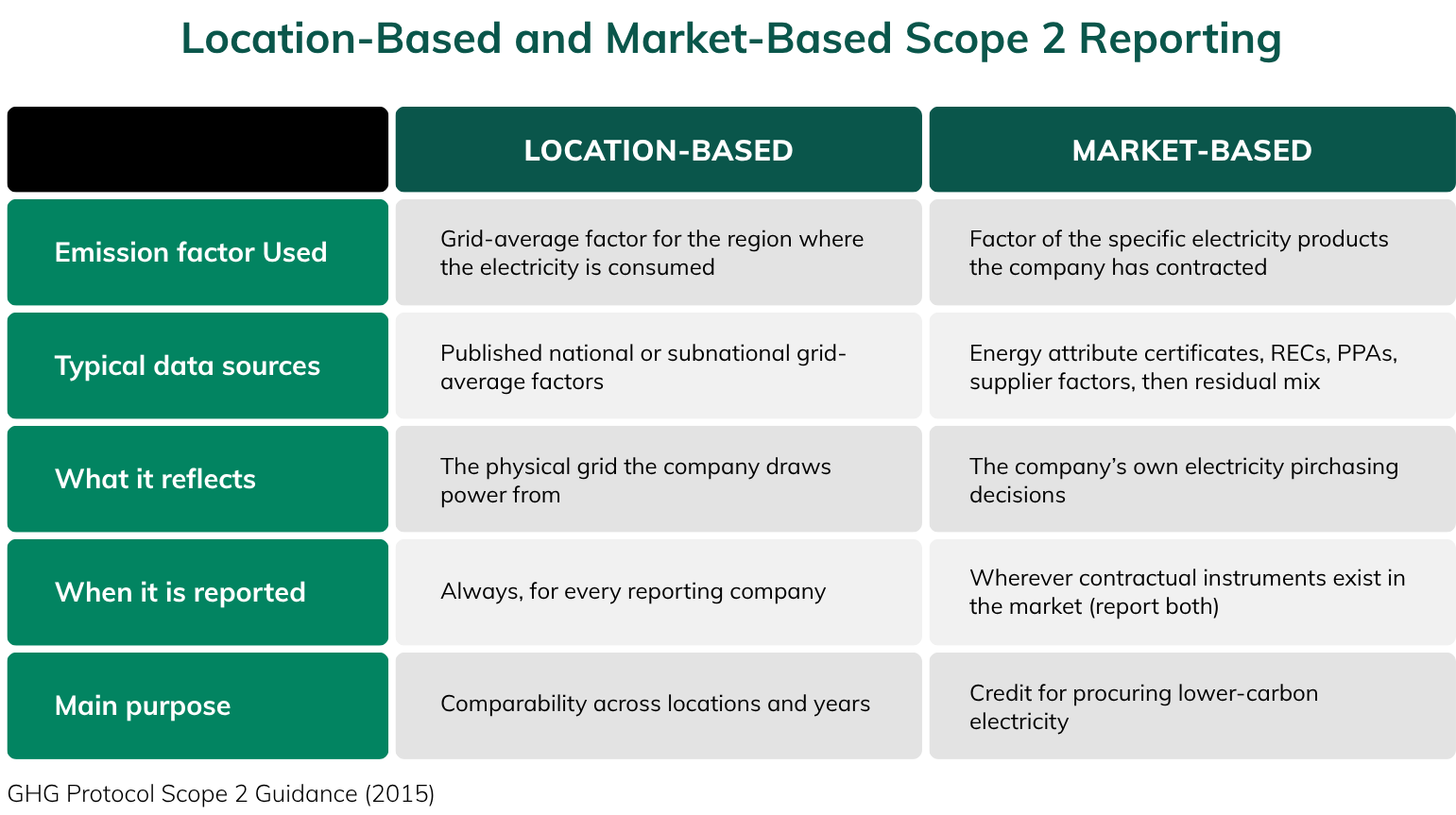
Scope 2 dual reporting means disclosing both a location-based and a market-based figure. The GHG Protocol Scope 2 Guidance requires both wherever contractual instruments are available in the market, including when the company holds none. It is the step that catches out the most inventories in their first year.
The GHG Protocol Scope 2 Guidance, published in 2015 as an amendment to the Corporate Standard, requires dual reporting wherever a company operates in a market where contractual instruments (such as energy attribute certificates, renewable energy certificates, or power purchase agreements) are available. Dual reporting means disclosing both the location-based Scope 2 figure and the market-based Scope 2 figure.
This requirement is widely misunderstood. Dual reporting applies even if the company has not purchased any renewable energy certificates or specific electricity contracts. The market-based method must still be reported, and where no contractual instruments are held, the residual mix or grid average is used following the emission factor hierarchy set out in the Scope 2 Guidance.
Scope 2 in the Indonesian market
For the location-based figure, use the national grid emission factor published by Kementerian ESDM for the relevant electricity system. It is updated periodically, so record which year’s factor you applied.
For the market-based figure, contractual instruments do exist in Indonesia, which is what triggers dual reporting locally. PLN has issued Renewable Energy Certificates since 2020, and Bappebti Regulation No. 11 of 2024 (issued 23 January 2025) set up exchange-based REC trading, though the designated exchange and clearing infrastructure were still being finalised at the time of writing. Because these instruments are available in the market, a company must report a market-based figure even if it holds none, using the residual mix or grid average under the Scope 2 Guidance emission-factor hierarchy. Verify the latest REC availability and any published Indonesian residual mix before you report.
Step 6: Cover the Scope 3 Categories That Are Actually Material
Covering Scope 3 means reporting the value-chain categories that are material to your business and documenting why the rest are excluded. Of the 15 GHG Protocol categories, purchased goods and services and use of sold products usually dominate the footprint, so a defensible inventory prioritises those over the categories that are merely easy to measure.
What is a materiality assessment?
A materiality assessment is the documented process of testing each of the 15 Scope 3 categories against relevance criteria, such as expected size, influence, risk, and stakeholder expectations, and recording which categories you include, which you exclude, and why. It is the evidence a verifier uses to judge whether your Scope 3 boundary is defensible.
Scope 3 is where inventory scope creep meets inventory scope avoidance. The temptation is to cover the categories that are easy to measure, such as business travel and employee commuting, and quietly skip the ones that dominate the footprint, such as purchased goods and services and use of sold products.
Scope 3 is the hardest and trickiest part of any inventory, and it is worth saying so plainly. The data sits outside your organization, with suppliers and customers who measure it differently or not at all, so most of it has to be estimated rather than metered. That is why Scope 3 usually takes the longest to build and draws the most questions in a review.
Does every company have to report Scope 3? Under the GHG Protocol Corporate Standard, Scope 3 is a separate, optional inventory, so a company reporting only Scope 1 and 2 can still be compliant with that standard. Even so, value-chain emissions often dominate the total footprint, so measuring the material Scope 3 categories usually reveals more than leaving them out.
The GHG Protocol Corporate Value Chain (Scope 3) Accounting and Reporting Standard, published in 2011, lists 15 Scope 3 categories across upstream and downstream activities. You are not required to cover all 15. You are required to justify which ones you include, which ones you exclude, and why, using a materiality assessment that verifiers can follow.
| Upstream (8 categories) | Downstream (7 categories) |
| 1. Purchased goods and services
2. Capital goods 3. Fuel- and energy-related activities 4. Upstream transportation and distribution 5. Waste generated in operations 6. Business travel 7. Employee commuting 8. Upstream leased assets |
9. Downstream transportation and distribution
10. Processing of sold products 11. Use of sold products 12. End-of-life treatment of sold products 13. Downstream leased assets 14. Franchises 15. Investments |
How do you choose which categories to include? The GHG Protocol Scope 3 Standard points to a set of relevance tests, such as the size of the likely emissions, the influence you have to reduce them, the risk they create for the business, what stakeholders expect, whether the activity is outsourced, and any sector guidance that applies. Run each of the 15 categories against those tests, write down the result, and you have a materiality assessment a verifier can follow. For most companies, purchased goods and services (Category 1) and use of sold products (Category 11) dominate the footprint, so those are rarely defensible to leave out.
Document your estimation logic and assumptions clearly. Estimates are acceptable when they are explained. A purchased-goods figure derived from spend-based methodology and industry-average emission factors is defensible if the calculation is transparent. The same figure with no traceable method behind it is not.
Clarify category boundaries early, for example what belongs in Category 1 (purchased goods and services) versus Category 4 (upstream transportation and distribution), to avoid double counting and rework. Anyone building an inventory that will pass a materiality challenge needs this classification work done before the reporting year closes. The boundary calls between categories are where most first-time reporters slip, and the ten most common Scope 3 emissions challenges are worth reviewing before you finalize your category list.
Step 7: Reconcile Every Number Against a Source Document
Reconciliation means matching every activity-data figure in the inventory to a primary source document, such as an invoice, a utility bill, a submeter reading, or a signed contract, before the reporting deadline, and keeping that reconciliation trail as part of the inventory documentation so a verifier can follow how each number was checked.
Reconciliation is the step that separates a defensible GHG Inventory Report from a spreadsheet. Every activity data figure in your inventory should be matched against a primary source document, such as an invoice, a utility bill, a submeter reading, or a signed contract, before the reporting deadline, not after.
Keep the reconciliation trail itself as part of your documentation. Verifiers want to see how a number was checked, not just that it was. A reconciliation log that records the source document reference, the entry, the responsible reviewer, and the sign-off date is the difference between an inventory that passes on the first review and one that comes back with a list of open items.
This is also where centralized carbon accounting software earns its cost. Reconciling Scope 1, 2, and 3 data across multiple facilities and subsidiaries in a set of disconnected spreadsheets is where errors compound silently. TruCount centralizes activity data with a traceable audit trail and produces the location-based and market-based Scope 2 figures automatically, which removes one of the most common sources of first-year gaps in a first inventory.
Step 8: Run a Pre-Verification Check Before the Verifier
A pre-verification check is a dry run of the formal review, carried out with a verification provider before the VVB audit begins. It tests boundary documentation, IMP completeness, emission factor sourcing, Scope 2 dual reporting, Scope 3 category selection, and reconciliation coverage, and returns a written list of gaps you can close before the formal review.
The last step in how to build a GHG Inventory Report is the one most first-time reporters skip, and it is the one that saves the most cost. Engage a verification provider early, before the formal review, for a pre-verification check.
Issues caught in a pre-check are cheaper to fix than issues caught during the formal review. A typical pre-check covers boundary documentation, IMP completeness, emission factor sourcing, Scope 2 dual reporting, Scope 3 category selection, and reconciliation coverage. The output is a written list of gaps you can close in weeks rather than the days you will have during a formal verification.
Running the first pre-verification check in the year before your first formal review is the practical way to arrive at that review with an inventory that already stands up against verification.
When to Bring in a GHG Inventory Report Consultant
Building your Scope 1, 2, and 3 inventory is one task. Making it defensible in front of a verifier is another, and it is mostly a governance and documentation question rather than a calculation on. That is why an experienced consultant makes the difference. Someone who has sat on both sides of a verification review knows which boundary decisions get challenged, which emission factor choices need a paper trail, and how to structure the IMP so the first verification does not turn into a rebuild.
Whether you are building your first inventory or strengthening your annual inventory, getting the Inventory Management Plan and reconciled data right is what makes it audit-ready. TruCarbon’s climate advisory team can help you build a GHG Inventory Report that holds up under verification.
And if your problem is messy data, with numbers scattered across disconnected spreadsheets and no clear picture of where your GHG position stands, that is what TruCount is built to solve. It pulls your Scope 1, 2, and 3 data into one place with a clear audit trail, so building the inventory stops being a spreadsheet-wrangling exercise.
FAQ: How to Build A GHG Inventory Report
What is a GHG Inventory Report?
A GHG Inventory Report is a company’s quantified list of greenhouse gas emissions across Scope 1 (direct emissions), Scope 2 (purchased energy), and Scope 3 (value chain emissions) sources over a defined reporting period, prepared in accordance with an accounting standard such as the GHG Protocol Corporate Standard.
How long does it take to build a GHG Inventory Report?
Building a GHG Inventory Report for the first time typically takes three to six months for a mid-sized company, depending on the number of facilities, the maturity of activity data systems, and the depth of Scope 3 coverage. Companies with strong utility billing systems and existing environmental management processes tend to move faster.
What is the difference between location-based and market-based Scope 2?
Location-based Scope 2 uses the average emission factor of the electricity grid in the location where the consumption occurs. Market-based Scope 2 uses the emission factor of the specific electricity products the company has contracted, such as renewable energy certificates or power purchase agreements. The GHG Protocol Scope 2 Guidance requires both figures wherever contractual instruments are available in the market.
Do I need an Inventory Management Plan?
Yes, if you want an audit-ready inventory. Chapter 7 of the GHG Protocol Corporate Standard sets out how to build an inventory quality management system, and the Inventory Management Plan that has grown out of that guidance is one of the first documents a verifier asks to see. The IMP is the document that turns the exercise of how to build a GHG Inventory Report into a repeatable process rather than a one-off project.
Which Scope 3 categories must I include?
The GHG Protocol Corporate Value Chain Standard lists 15 Scope 3 categories across upstream and downstream activities. Companies are required to cover the categories that are material to their business and to justify inclusion or exclusion using a materiality assessment. There is no fixed minimum number of categories, but the assessment must be documented.