
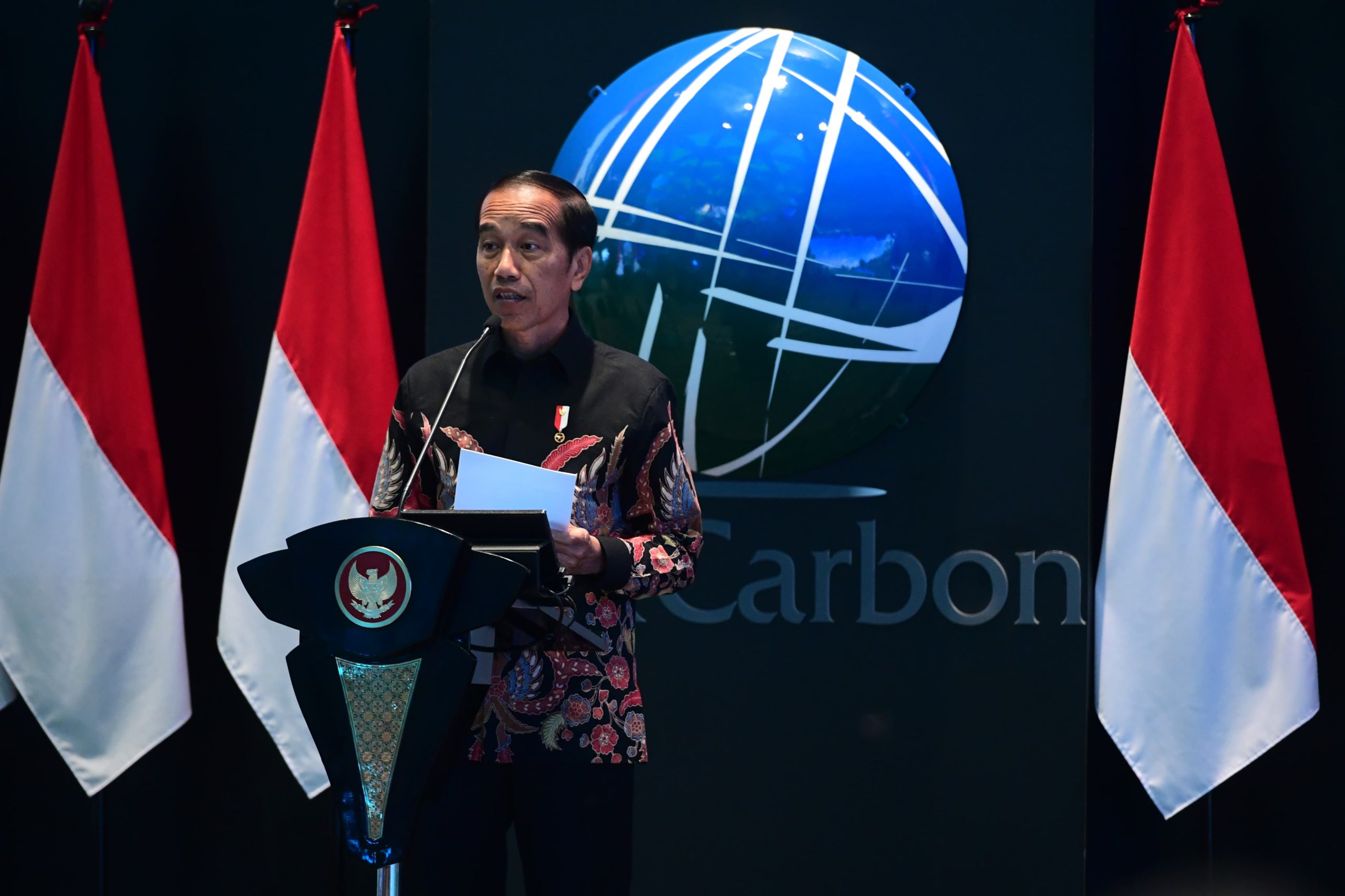
Understanding how IDXCarbon works comes down to two questions: what you can trade, and how you get access to trade it. IDXCarbon, the Indonesia Carbon Exchange, is the country’s official carbon exchange, operated by the Indonesia Stock Exchange (IDX) and supervised by the Financial Services Authority (Otoritas Jasa Keuangan, OJK). It launched on 26 September 2023 and opened to international buyers in January 2025. This guide covers the exchange itself, what you can trade, the four trading mechanisms, the fees, and how to register, for the two groups who use it, project developers and buyers.
How IDXCarbon works in trading is governed by OJK Regulation (POJK) No. 14 of 2023, as amended by POJK No. 10 of 2026. The 2026 amendment aligns the exchange with Indonesia’s updated carbon-market architecture under Presidential Regulation No. 110 of 2025, including interoperability with the national carbon unit registry, SRUK, and the requirement that any unit traded on the exchange first be recorded there.
What Is and How IDXCarbon Works
IDXCarbon is a single regulated platform that brings both types of carbon instruments, allowances and credits, into a single marketplace. Before getting into how IDXCarbon works step by step, it helps to see what the exchange is built to do. Its design choices are what set it apart, and they matter directly to how a buyer or seller uses it:
- All carbon products in one platform. It combines carbon allowances (PTBAE-PU) and carbon credits in one marketplace.
- OJK supervision and surveillance. It operates under Indonesia’s FSA (OJK), giving the market regulatory oversight and monitoring.
- Private blockchain system. The trading system is built on a private blockchain to improve traceability of units and minimise the risk of double-counting and double-claiming.
- Linked to the national registry, with multi-registry capability. It is connected to SRN PPI and SRUK as Indonesia’s national registry and can connect with other registries for traceability and integrity.
- Four trading mechanisms. Auction, Spot (Regular), Negotiated, and Marketplace, so buyers and sellers can pick the method that suits them.
- Very low trading fee. Between 0.11% and 0.22%, among the lowest in the world.
- Free registration, membership, listing, and retirement. IDXCarbon waives these fees to encourage participation.
By June 2026, IDXCarbon had traded 1.98 million tCO2e cumulatively, worth over IDR 93.81 billion, across roughly 155 registered participants (IDXCarbon, June 2026). International trading, opened in January 2025, moved 41,822 tCO2e on its debut session, and authorised international volume reached 49,807 tCO2e across 22 transactions. Retirements have supported Scope 1–3 voluntary offsetting and emission-trading-scheme compliance, as well as milestones such as Indonesia’s first carbon-neutral flight and first eco-conscious wedding. Volumes are still modest relative to Indonesia’s potential, which means well-prepared early participants still have room to establish positions. That combination of low fees and a still-maturing order book works to the advantage of those who join early.
What You Can Trade on IDXCarbon
Knowing how IDXCarbon works starts with knowing what actually trades on it. The exchange runs two product lines, allowances and credits. Credits, in turn, can be issued under Indonesia’s own registry (SPE-GRK) or, increasingly, come from other registries. Separately, every credit can be classified under Article 6, which we cover at the end of this section.
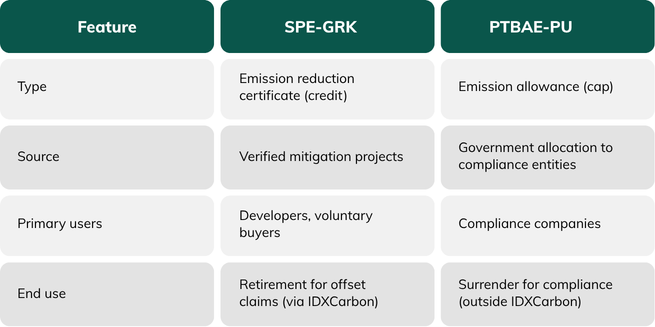
PTBAE-PU (Carbon Allowance)
- Full name: Persetujuan Teknis Batas Atas Emisi Pelaku Usaha (on IDXCarbon also labelled Kuota Emisi GRK).
- What it is: a technical approval of an emission ceiling, effectively an emission allowance allocated to a compliance entity for a set period by the relevant ministry.
- Who uses it: compliance companies, to stay within their allocated cap.
- How it ends: surrendered to the ministry for compliance, which is done outside IDXCarbon.
SPE-GRK (Carbon Credit)
- Full name: Sertifikat Pengurangan Emisi Gas Rumah Kaca.
- What it is: the greenhouse gas emission reduction certificate issued specifically under Indonesia’s national registry (SRN/SRUK). One SPE-GRK represents one tonne of CO2e reduced or removed by a verified mitigation project.
- Important: SPE-GRK is registry-specific to Indonesia. Not every carbon credit on IDXCarbon is an SPE-GRK (see the next category).
- Who uses it: voluntary buyers and project developers.
- How it ends: retired through IDXCarbon to make a carbon offset claim.
Non-SPE-GRK Carbon Credits (from Other Registries)
SPE-GRK is not the only credit type relevant to IDXCarbon. The exchange is built with multiple-registry connectivity, and Indonesia has begun recognising credits issued under other registries:
- International carbon standards. IDXCarbon can be used to trade carbon credits issued under international carbon standards, such as Verra, Gold Standard, and Plan Vivo.
- International/bilateral agreements and CORSIA. Separately, demand comes through agreement-based routes: bilateral agreements between countries such as Joint Crediting Mechanism (JCM) and compliance schemes such as CORSIA. What sets these apart from the standards above is that eligibility is agreement-based; a credit must satisfy the terms of a specific bilateral arrangement or CORSIA’s rules, not simply be issued under a recognised standard.
In short, alongside PTBAE-PU and SPE-GRK, IDXCarbon can facilitate non-SPE-GRK carbon credits from other registries, and this scope is expanding as SRUK is established.
How Credits Are Classified Under Article 6
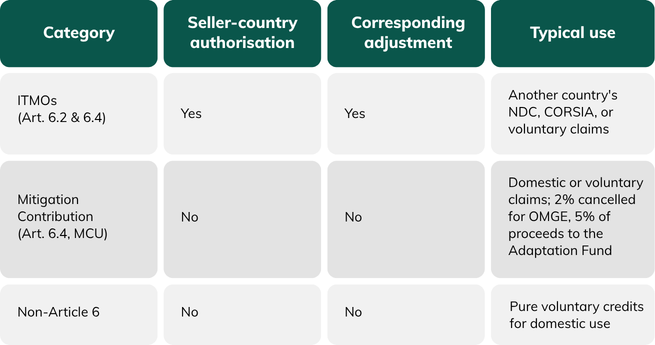
Whatever registry a credit comes from, its treatment on the exchange also depends on its Article 6 status. Credits are grouped into three broad categories, defined by whether the seller country authorises the credit and applies a corresponding adjustment. A corresponding adjustment is an accounting step that prevents two countries from counting the same emission reduction twice.
- ITMOs (Article 6.2 and 6.4). Authorised by the seller country with a corresponding adjustment. They can be used toward another country’s NDC, for international schemes such as CORSIA, or for voluntary claims.
- Mitigation Contribution (Article 6.4). Not authorised by the seller country and carrying no corresponding adjustment. These are issued as Mitigation Contribution Units (MCUs) for domestic use or voluntary claims; 2% is cancelled for Overall Mitigation in Global Emissions (OMGE) and 5% of proceeds goes to the Adaptation Fund.
- Non-Article 6. Pure voluntary carbon credits for domestic use, transacted without government authorisation.
How Trading Works: The Four Mechanisms
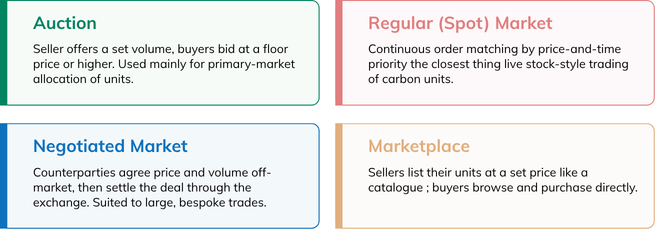
IDXCarbon runs two market levels. The primary market is for the first sale of units (mainly via auction), and the secondary market is where units already in circulation change hands. Across these levels, it offers four mechanisms, so participants can choose how they buy and sell. This is the part most buyers and sellers deal with day-to-day.
Auction
The seller offers a fixed volume, and buyers place bids at or above the floor price, with allocation determined by the bids. Auctions are used mainly for primary-market allocation of units, for example when the government releases allowances or a large seller places a first tranche.
Regular (Spot) Market
Buy and sell orders are matched continuously on a price-and-time priority basis, the closest thing to live, stock-style trading of carbon units. The best-priced order is filled first, and among equal prices the earliest wins, which is how a transparent market price forms.
Negotiated Market
Counterparties agree the price and volume off-market and then settle the pre-agreed deal through the exchange. This suits large or bespoke transactions where both sides want certainty before execution.
Marketplace
Sellers, typically project developers, list their units at a set price like a catalogue, and buyers browse and purchase directly. It is the simplest route for a developer to make credits available, and often the first place a new buyer looks.
Whichever mechanism is used, a completed trade is cleared and settled through the exchange, and ownership is updated in the SRUK registry, so every unit ends up with a single verifiable owner. This settlement-and-registry step is the quiet backbone of the exchange, because it is what makes each traded unit trustworthy.
For Project Developers: Listing Carbon Units
If you develop carbon projects, the practical side is getting your units listed and sold. The exchange is deliberately flexible about how much you sell and when.
- A unit must already be issued and recorded in the national registry as SPE-GRK or PTBAE-PU before it can be listed on the exchange.
- You can list a portion, not all. A developer does not have to list every credit generated by a project. You can offer only part of your issuance on IDXCarbon and hold, sell elsewhere, or release the rest over time, which lets you manage price exposure and timing.
- Where units sell. Developers most often use the Marketplace to list at a chosen price, and can also sell through the Auction or Negotiated mechanisms for larger volumes.
- Listing and retirement are free; only the low trading fee (0.11%–0.22%) applies when a trade executes.
To list, a developer registers as an exchange service user through the same onboarding process buyers use, described below.
For Buyers: How to Register and Trade
Access is the other half of the picture. Two kinds of entity can become service users: Indonesian legal entities and foreign institutions.
International access is a common question, and the answer is there are two routes. They can register directly with IDXCarbon as a foreign institution, which requires a Legal Entity Identifier (LEI) with proof of registration on the Regulatory Oversight Committee (ROC), among other documents. Alternatively, they can partner with and trade through an existing Indonesian IDXCarbon user acting as an intermediary.

The registration flow runs as follows:
- Apply online. Submit the registration request form linked from the IDXCarbon Join Us page. You then receive the full procedure and a shared folder for uploading documents.
- Prepare company documents. Indonesian entities provide, among others, the registration form, a signed and stamped statement letter, articles of association (AD/ART), the deed of establishment and its ministry approval, tax ID (NPWP), business registration number (NIB), a beneficial-owner list, at least one year of financial statements, and bank and registry account details. Foreign companies instead provide the company deed of establishment, business registration number, an LEI with ROC proof, one year of financial reports, and bank account details. Check the IDXCarbon website for the precise, current document requirements.
- Register your users. At least two representatives must complete IDXCarbon’s carbon-exchange (PBK) training and use company-domain email, then submit appointment letters, ID, a photo, and their training certificate.
- Open the securities account. IDXCarbon reviews a complete application within about five exchange (PBK) days and issues an approval letter within about five more once the review finishes; incomplete or non-qualifying applications are returned with reasons.
- Fund and trade. Once your securities (Efek) account is open, log in at trade.idxcarbon.co.id to place orders across the four mechanisms.
On cost, registration, membership, listing, and retirement are free, and the trading fee is 0.11%–0.22%. IDXCarbon’s fee circular sets out the specifics. Taken together, these steps take a buyer from first application to a live, funded trading account.
Why the Market Matters for Buyers and Developers
The mechanics are more useful alongside a view of where demand is heading. IDXCarbon frames Indonesia’s opportunity across four segments, and whether a corresponding adjustment is required differs by segment.
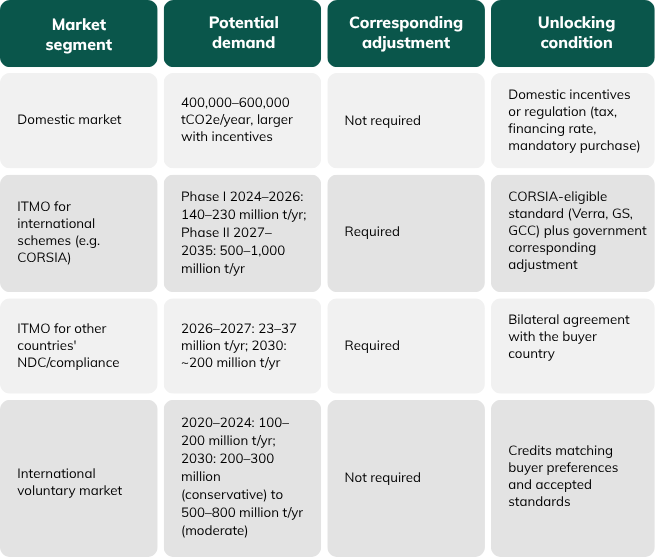
Two dates drive the market outlook of how IDXCarbon works: the mandatory phase of CORSIA from 2027 and Indonesia’s NDC checkpoint in 2030. As both approach, IDXCarbon expects compliance and ITMO demand to grow even as the voluntary market recovers. The mechanics matter most when paired with this demand picture, because it tells developers what to build and buyers what to secure.
How TruCarbon Helps
Successful participation depends on getting the work before the trade right: for developers, preparing projects and units that meet technical, regulatory, and registry requirements; for buyers, assessing the integrity and category of the units on offer. Understanding the exchange is the starting point, but turning that understanding into a sound transaction is where most of the value is won or lost.
TruCarbon supports both. Our climate advisory team helps companies build carbon strategies and evaluate units, while TruMRV supports the measurement, reporting, and verification that give carbon units their integrity.
Frequently Asked Questions
- How does IDXCarbon work?
IDXCarbon works as Indonesia’s official carbon exchange. Verified, registered carbon units are traded through four mechanisms, Auction, Regular (Spot) Market, Negotiated Market, and Marketplace, under OJK supervision. Buyers and developers register as service users, trades are settled through the exchange, and ownership is updated in the SRUK registry.
- Who operates and regulates IDXCarbon?
IDXCarbon is operated by the Indonesia Stock Exchange (IDX) and supervised by the Financial Services Authority (OJK). It launched on 26 September 2023 and operates under OJK Regulation No. 14 of 2023, as amended by POJK No. 10 of 2026.
- Can international buyers trade on IDXCarbon?
Yes. Since January 2025, foreign institutions can either register directly with IDXCarbon (providing an LEI with ROC proof, among other documents) or trade through an existing Indonesian IDXCarbon user acting as an intermediary.
- How do I register and open an account on IDXCarbon?
Apply through the registration request form on the IDXCarbon Join Us page, submit the required company and user documents, complete PBK training for at least two users, and IDXCarbon opens your securities account after review (roughly five days to review plus five to approve). Check the IDXCarbon website for the exact document list.
- How IDXCarbon work in terms of the trading mechanisms?
Auction (bidding at a floor price, mainly primary market), Regular or Spot Market (continuous price-time order matching), Negotiated Market (pre-agreed deals settled on-exchange), and Marketplace (sellers list units at a set price for buyers to purchase).
- Does a project developer have to list all their carbon credits?
No. A developer can list only a portion of a project’s credits on IDXCarbon and hold or sell the rest elsewhere or over time.
- What does it cost to use IDXCarbon?
Registration, membership, listing, and retirement are free. The trading fee is 0.11%–0.22%, among the lowest globally. See IDXCarbon’s fee circular for details.
- What carbon units and credit categories trade on IDXCarbon?
The two product lines are allowances (PTBAE-PU, also called Kuota Emisi GRK) and carbon credits. Credits include SPE-GRK issued under Indonesia’s registry and, through multi-registry connectivity, non-SPE-GRK credits from other registries such as Verra. Under Article 6, credits are further classified as ITMOs (authorised, with a corresponding adjustment), Mitigation Contribution units (no corresponding adjustment), or non-Article 6 voluntary credits.
- Can IDXCarbon trade carbon credits from registries other than Indonesia’s?
Yes, increasingly. IDXCarbon has multiple-registry connectivity, and Indonesia’s updated carbon-market framework under Presidential Regulation 110/2025, together with the interoperable SRUK registry (launched July 2026), allows non-SPE-GRK credits from other registries to be recognised and traded, particularly for international and CORSIA-eligible transactions.