

A high-quality carbon credit represents one tonne of CO2 that was genuinely reduced, avoided, or removed, and it carries the evidence to prove it: a conservative baseline, an approved methodology, independent verification, and monitoring data anyone can inspect. That evidence is what separates two credits that look identical on paper. Both can carry a one-tonne label and the same registry logo, but one is backed by a defensible baseline and a low reversal risk, while the other rests on an outdated methodology or an inflated baseline that a ratings agency, an auditor, or a regulator can later reject.
The market prices that difference between high-quality carbon credits and the lower ones. In its year-end 2025 analysis, MSCI Carbon Markets found that higher-quality credits (rated BBB and above) averaged USD 6.8 per tonne across 2025, up from USD 5.6 in 2024, while the overall market index averaged USD 3.5 over the same year. Those are full-year averages. The gap was wider at the close of the year.
By December, the spread between top-rated credits and the index exceeded USD 7.0, implying a premium of around 360% as high-integrity supply outpaced the rest of the market (MSCI Carbon Markets, 2025). Buyers pay a high-quality carbon credit not for the certificate, but for the lower risk that the credit is later downgraded, challenged, or invalidated.
This article explains what separates a high-quality carbon credit from reputational and regulatory risk: the principles that define climate integrity, why a verified credit is not automatically a high-quality one, how quality sets price, and how credible carbon projects are built before a single credit is issued.
Why High-Quality Carbon Credits Are Becoming the Industry Standard
For most of the past decade, the voluntary carbon market grew on volume. A wave of investigative reporting and academic scrutiny between 2022 and 2024 changed that, exposing projects whose claimed reductions did not match reality. The correction that followed is now visible in the data.
Sylvera reported that 57% of Sylvera-rated credits retired in the first half of 2025 carried a BB grade or higher, up from 52% in 2024, as buyers moved away from cheaper, lower-rated supply (Sylvera, 2025). Ratings agencies grade credits on a lettered scale from AAA down to D, much like credit ratings, with AAA the highest and D the lowest. A BB sits in the middle band, so the move toward BB and above reflects buyers shifting into the more credible half of the market (Sylvera).
Demand for high-integrity carbon credits is concentrating at the top for a reason. Investors, regulators, and customers increasingly ask companies to show that the credits behind a climate claim are real. Disclosure regimes such as the EU’s CSRD and tightening rules on environmental marketing mean an unsupported offset claim is no longer only a communications problem. It is a compliance and litigation exposure.
The infrastructure has caught up to the expectation. The Integrity Council for the Voluntary Carbon Market (ICVCM) now publishes its Core Carbon Principles, a threshold that assesses crediting programs and methodologies against a common integrity bar (ICVCM). Removal credits, which are easier to measure and less exposed to reversal, show the premium on quality: they traded at roughly 381% above reduction credits in 2024, up from about 245% in 2023 (Ecosystem Marketplace, reported 2025).
A high-integrity carbon market rewards this shift. The point for buyers is direct: purchasing carbon credits is easy, but purchasing credits that a ratings agency, an auditor, or a regulator will accept is the actual task, and quality is what decides it.
What Defines a High-Quality Carbon Credit?
High-quality carbon credits are not a single attribute. It is a set of conditions a credit must meet at the same time. The ICVCM groups these under governance, emissions impact, and sustainable development. The four dimensions below reorganize those principles into the questions that drive carbon project quality, and that a buyer actually needs to answer.
Climate Integrity
Climate integrity asks whether the tonne is real. Three tests matter most in checking if a carbon credit is high-quality. Additionality means the reduction or removal would not have happened without carbon finance; a project that would have proceeded anyway does not create a new climate benefit. Permanence means the stored or avoided carbon stays out of the atmosphere, or, where reversal is possible (a forest fire, for example), that buffer reserves and monitoring are in place to compensate for it. No double counting means the same tonne is not claimed twice, which is why registry tracking and, for cross-border transfers, corresponding adjustments matter.
Scientific Credibility
A high-quality credit rests on conservative, transparent measurement. Baselines (the emissions that would have occurred without the project) should be set cautiously, so the project does not over-claim. Quantification should follow a methodology approved under a recognized standard and suited to the activity, and monitoring should rely on measured data rather than assumption. When measurement is uncertain, credible projects err toward under-crediting rather than over-crediting.
Environmental and Social Integrity
Real projects operate in real places, among real communities. High-integrity credits carry safeguards that prevent harm and, ideally, deliver co-benefits: biodiversity protection, better water management, and local livelihoods. Free, prior, and informed consent from affected communities is a baseline expectation, not an add-on. A project that reduces emissions while displacing residents or degrading habitat is not high quality, whatever its tonnage.
Governance and Transparency
Trust is built on visibility. A quality credit is issued under a recognized standard, recorded in a public registry, and validated and verified by an accredited, independent third party. Project documentation, monitoring reports, and issuance records should be open to inspection. If a buyer cannot trace a credit from the field to the registry, the credit cannot be assessed, and what cannot be assessed cannot be trusted.
If Credits Are Verified, Why Isn’t Every Credit High-Quality?
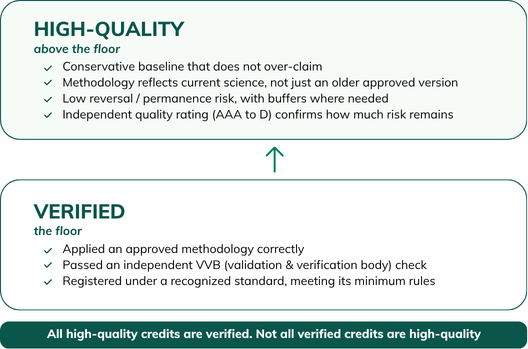
Every credit issued under a recognized standard has already passed validation and verification by an accredited third party (a validation and verification body, or VVB) and been registered against a published methodology. That check is a genuine one: it confirms the project met the minimum requirements of its chosen standard and methodology. What it does not do is rank the credit against stronger or weaker ones. It is not a guarantee of quality, for three practical reasons.
First, verification confirms that a project applied its chosen methodology correctly. It does not re-open whether that methodology still reflects current science. Methodologies are written in a given year and revised later, so a credit issued under an older baseline method can pass every check and still overstate the reduction against what today’s rules would allow. This is why the ICVCM has assessed existing methodologies against the Core Carbon Principles and found that many do not meet the current bar (ICVCM, 2024 to 2025).
Second, baselines involve judgment. A baseline is a counterfactual, an estimate of what would have happened without the project. Two developers can build defensible but very different baselines for similar projects, and both can pass verification. A conservative baseline produces fewer, sturdier credits; an aggressive one produces more credits of poorer quality.
Third, additionality and permanence risk are project-specific and are never fully removed by a checklist. A verified credit can still sit on land that faced little real threat of conversion, or store carbon that a future fire could release. The rulebook reduces these risks. It does not erase them.
This is why independent ratings agencies such as BeZero, Sylvera, and MSCI Carbon Markets exist. They score verified credits on a scale precisely because ‘verified’ and ‘high-quality’ are not the same statement. Verification tells a buyer the credit is real enough to issue. A quality rating tells the buyer how much risk still sits inside it.
How High-Quality Carbon Credits Are Built, Stage by Stage
Integrity is designed into a project before a single credit is issued. These stages describe how credible developers approach the work.
Selecting the Right Project Opportunity
Quality begins with site selection. A strong project targets a genuine, additional climate need (degraded peatland at risk of fire, or forest under credible threat of conversion) rather than land that would remain protected anyway. Early feasibility work tests additionality, land tenure, and baseline conditions before capital is committed.
Choosing Appropriate Methodologies
The methodology is the scientific backbone of the credit. Developers match the activity to an approved methodology under a recognized standard, and confirm it reflects current science. Methodologies are revised over time, so a credit’s risk profile depends on which version was used and when. In Indonesia, forestry-based projects also operate within national rules such as Permenhut 6/2026 on forestry carbon trading, issued under the wider Perpres 110/2025 carbon framework, which shapes how projects are approved and credited.
Establishing Rigorous Monitoring Systems
Measurement, reporting, and verification (MRV) turn field activity into a defensible number. High-quality projects invest in continuous monitoring (remote sensing, ground sensors, and field transects) so that claimed outcomes can be checked against observed reality. The strength of the MRV system determines how far a buyer can rely on the credit.
Engaging Local Communities and Stakeholders
Projects that ignore the people who live on the land tend to fail, environmentally and commercially. Credible developers secure consent, share benefits, and build local roles into project operations. Community fire patrols, for instance, often protect stored carbon more effectively than any external control.
Maintaining Long-Term Project Governance
Carbon projects run for decades. Long-term governance (clear ownership, financial durability, and ongoing verification cycles) is what keeps a credit credible years after issuance. A developer’s ability to sustain monitoring and management across the full crediting period is part of what buyers are assessing.
Why High-Quality Carbon Credits Matter for Corporate Climate Strategies
For a company, credit quality is a strategic decision, not a procurement detail.
A credible net-zero strategy depends on credits that regulators and auditors will accept. Low-integrity credits used against a public target expose the company to the risk that the claim is later challenged and withdrawn, undoing the value of the investment. High-quality credits protect the claim.
A high-quality carbon credit also supports ESG and sustainability commitments that are increasingly reported under formal frameworks. When a company can show the additionality, permanence, and verification behind its portfolio, its disclosures pass investor and assurance-provider review.
Stakeholder trust follows the same logic. Customers, employees, and financiers respond to evidence, not adjectives. A verified project with public monitoring data is more persuasive than any sustainability slogan.
Quality is also a hedge against a moving regulatory line. Standards such as the ICVCM’s are raising the bar for what counts as a legitimate credit, and cross-border rules under Article 6 are tightening how internationally transferred credits are accounted for. Buying to today’s quality standard, and documenting the due diligence behind it, is how companies avoid holding credits that a future rule renders unusable.
Building Trust Through High-Integrity Carbon Projects
High-quality carbon credits are built on more than a verified number. They depend on sound project design, conservative science, transparent governance, and genuine environmental and social safeguards. Principles such as additionality, permanence, transparent MRV, and stakeholder engagement are what allow a carbon project to deliver measurable, lasting climate benefits.
For companies, understanding these foundations turns carbon credits from a liability into an asset. It enables sharper due diligence, more defensible climate claims, and better decisions about where to invest. As expectations around carbon market integrity keep rising, prioritizing high-quality carbon projects is how credible climate action and long-term business value get built.
How TruCarbon Builds and Assesses High-Quality Carbon Credits
These principles are the standard TruCarbon holds its own work to. As a carbon project developer and decarbonization advisor, TruCarbon designs projects around conservative baselines, approved methodologies, and monitoring data that verification bodies and ratings agencies can check, and it applies the same tests when advising buyers and investors on the credits they are weighing. If you are a buyer evaluating credits, or an investor assessing a carbon project, you can review the options with our expert team.
Frequently Asked Questions
What is a high-quality carbon credit?
A high-quality carbon credit represents one tonne of CO2 that was genuinely reduced, avoided, or removed, and carries the evidence to prove it: a conservative baseline, an approved methodology, independent verification, and public monitoring data. Independent ratings agencies, auditors, and registries can each confirm the claim, and the credit is unlikely to be downgraded or invalidated later.
If a carbon credit is verified, is it automatically a high-quality carbon credit?
No. Verification by an accredited third party (a VVB) confirms a project applied its methodology correctly and meets a registry‘s minimum rules. It does not confirm the methodology reflects current science, that the baseline was conservative, or that reversal risk is low. Independent ratings agencies score verified credits precisely because ‘verified’ is a floor, not a quality guarantee.
How does carbon credit quality affect price?
Price tracks risk. A higher-quality carbon credit is less likely to be downgraded, challenged, or invalidated, so it costs more, and top-rated credits carried a clear premium over the broader market through 2025. A cheaper credit usually reflects higher risk, and that risk can cost far more later than the money saved at purchase.
How can a company assess carbon credit quality before buying?
Carbon credit due diligence checks four things: climate integrity (additionality, permanence, no double counting), scientific credibility (conservative baselines and an approved methodology), environmental and social safeguards, and governance (recognized standard, public registry, independent verification). If a credit cannot be traced from the field to the registry, it cannot be assessed.
What is the difference between a carbon credit standard and a methodology?
A standard (such as Verra or Gold Standard) is the overall certification program. A methodology is the specific approach used to quantify reductions for a given project type. Two credits under the same standard can differ in quality depending on which methodology was used and when it was approved.
Are nature-based carbon credits high quality?
They can be, if they meet the same tests as any credit: additionality, permanence with reversal buffers, conservative quantification, and social safeguards. Nature-based projects such as peatland or forest protection deliver strong co-benefits, but quality depends on project design and MRV, not project type alone.