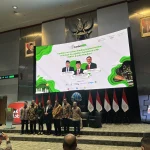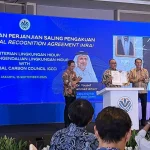

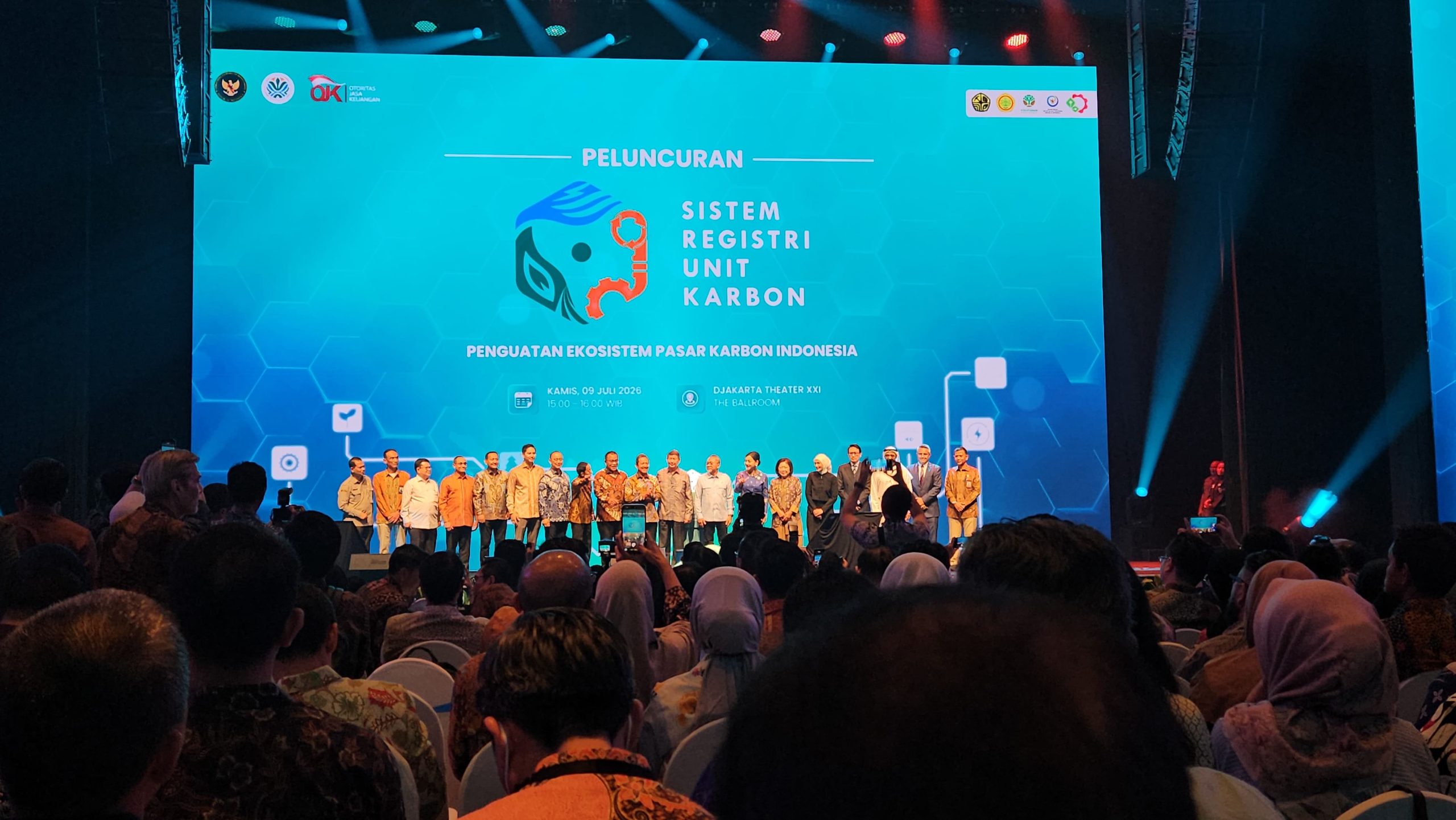
On 9 July 2026, Indonesia launched SRUK (Sistem Registri Unit Karbon, or Carbon Unit Registry System), a dedicated national registry for carbon units. It records the issuance, ownership, transfer, and retirement of tradable carbon units, a function previously handled through SRN PPI. SRUK was established under Peraturan Menteri Lingkungan Hidup/BPLH No. 10 Tahun 2026 (Permen LH/BPLH No. 10/2026; Minister of Environment/BPLH Regulation No. 10 of 2026), signed on 2 July 2026, within the carbon-market framework set by Peraturan Presiden No. 110 Tahun 2025 (Perpres No. 110/2025; Presidential Regulation No. 110 of 2025). Perpres No. 110/2025 Article 59(3) is the enabling clause: it directs that the detailed rules for recording carbon trading be set by a ministerial regulation after coordination with the steering committee, and Permen LH/BPLH No. 10/2026 is that regulation.
SRN PPI (Sistem Registri Nasional Pengendalian Perubahan Iklim) remains active, but its role has narrowed: it continues to record Indonesia’s climate mitigation and adaptation actions, while SRUK now handles carbon units as tradable assets. The distinction most summaries skip is that a climate action, a carbon project, a carbon unit, and a tradable asset are related but not the same thing, and SRUK is the system that keeps those distinctions straight as units move toward trading, including through IDXCarbon. This article explains the transition from SRN PPI to SRUK, how the new registry works across a project’s life, how it relates to IDXCarbon, and what it means for developers, buyers, and investors.
One feature sets SRUK apart internationally: at its launch, the Ministry of Environment/BPLH announced that Indonesia is the first country in the world to adopt the data standard of the Climate Data Steering Committee (CDSC), the Common Carbon Credit Data Model developed under the G20 Sustainable Finance Working Group. CDSC managing director Alice Carr has separately described SRUK as reflecting international best practice. That common standard is what lets SRUK interoperate cleanly with foreign registries, which matters directly for buyer confidence.
Why Indonesia Transitioned from SRN PPI to SRUK
SRN PPI (Sistem Registri Nasional Pengendalian Perubahan Iklim), launched in November 2016, was built to track Indonesia’s climate mitigation and adaptation actions against its Nationally Determined Contribution (NDC). As carbon trading formalized under Perpres No. 98/2021, the same system also served as the registry for tradable carbon units. Holding both functions in one place blurred the line between reported climate action and a financial asset, and it made Indonesian units difficult to reconcile with international registries.
Perpres No. 110/2025, signed on 10 October 2025, resolved this by splitting the registry into two. The regulation supersedes Perpres No. 98/2021 and consolidates Indonesia’s Carbon Economic Value (Nilai Ekonomi Karbon) framework. The split does two things at once:
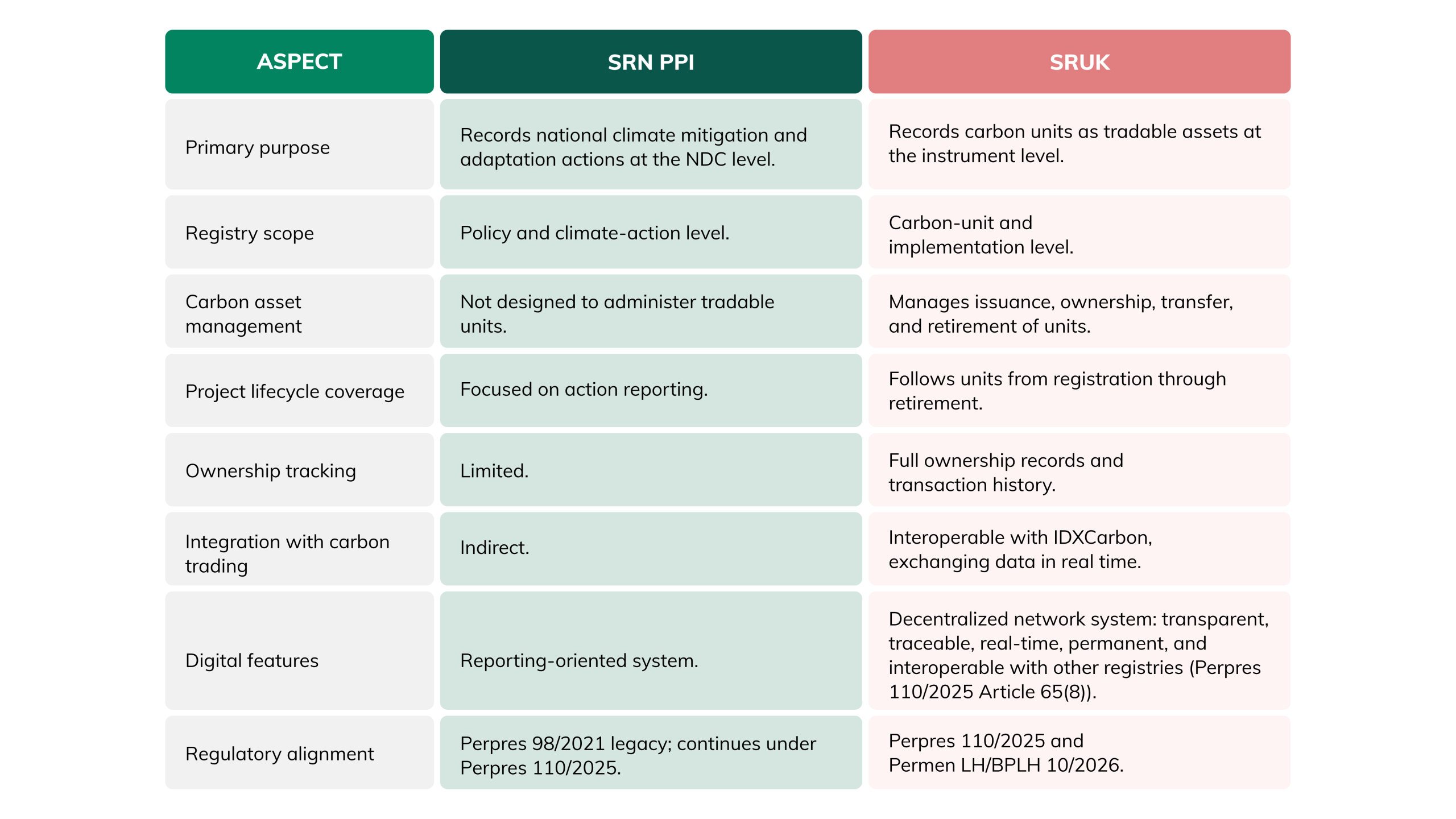
- SRN PPI continues as the national record of Indonesia’s climate mitigation and adaptation actions and the emission reductions that count toward its NDC.
- SRUK becomes the dedicated registry for carbon units, recording emission allowances (Kuota Emisi GRK) and offset credits (domestic SPE-GRK and international-standard non-SPE-GRK) through issuance, ownership, transfer, and retirement.
Perpres No. 110/2025 Article 75 places SRUK inside a five-part transparency framework alongside MRV, SRN PPI, SPE-GRK, and non-SPE-GRK records. For the full picture of the parent regulation, see our explainer on Perpres No. 110/2025.
Both SRN PPI and SRUK connect through NDC accounting. When a carbon unit is authorized for international use and transferred abroad, Indonesia hands the corresponding emission reduction to the acquiring country, which counts it toward its own climate target. Indonesia then applies a Corresponding Adjustment to prevent double counting, consistent with Article 6.2 of the Paris Agreement and the ITMO framework. The exported credit stays recorded in SRUK but no longer counts toward Indonesia’s NDC.
The separation matters because a unified, unit-only registry was a precondition for trading to scale. Perpres No. 110/2025 also decoupled carbon trading from the NDC timeline: Article 58(1) states that carbon trading is conducted without waiting for the NDC target to be met, which lifted the restriction that had limited international voluntary credit sales since 2022. A clean, traceable ledger of units sits between a verified project and a completed trade, and SRUK is that ledger.
The table below summarizes how the two registries now diverge.
How SRUK Works Throughout the Carbon Project Lifecycle
SRUK follows a carbon project across its whole lifecycle: from project registration and carbon-unit issuance to the ownership, transfer, and retirement of every issued unit. Minister of Environment/Head of BPLH Regulation No. 10 of 2026 sets the framework for registration, carbon-unit records, unit status, ownership, transfers, and retirement, and Perpres No. 110/2025 Article 65(8) describes SRUK as a decentralised network system. The sections below follow that order: how a project enters SRUK, how units are issued, and how the registry then records their ownership and transactions.
- Project Registration
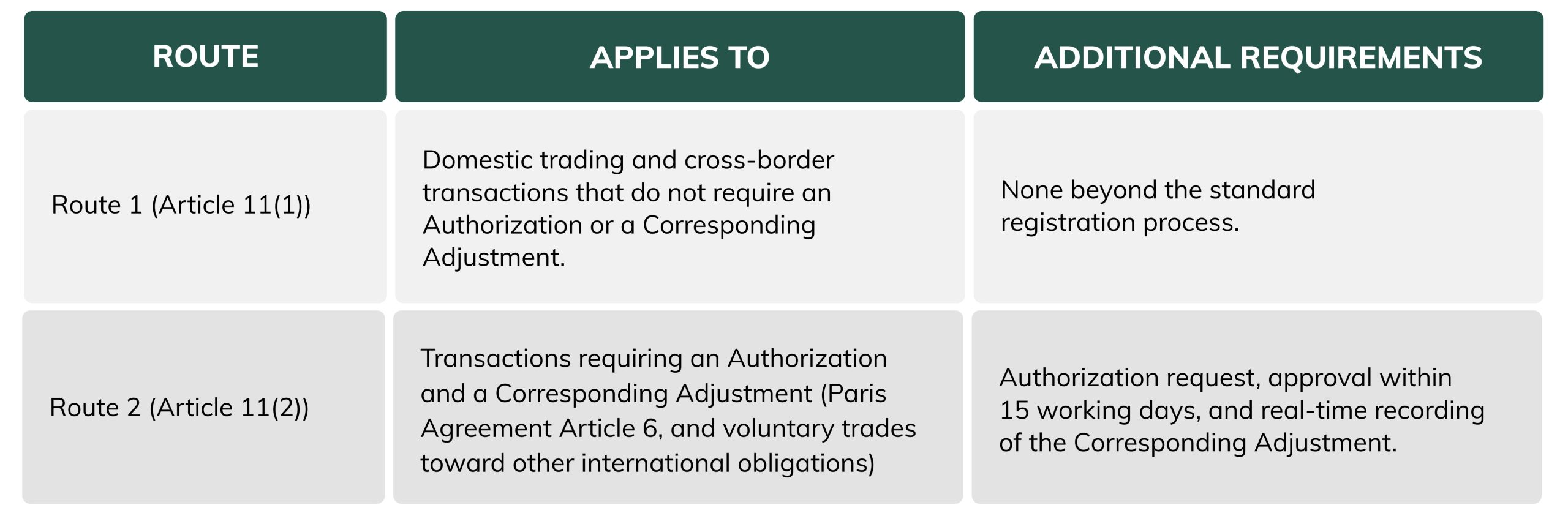
Registration is where it begins: a project records its mitigation activity and supporting documentation, establishing its identity, methodology, and boundaries before any carbon unit exists. Permen LH/BPLH No. 10/2026 Article 11 sets out two routes with the same core process, so the target market is not fixed at initial registration. Instead, the route depends on whether an Authorization is required.
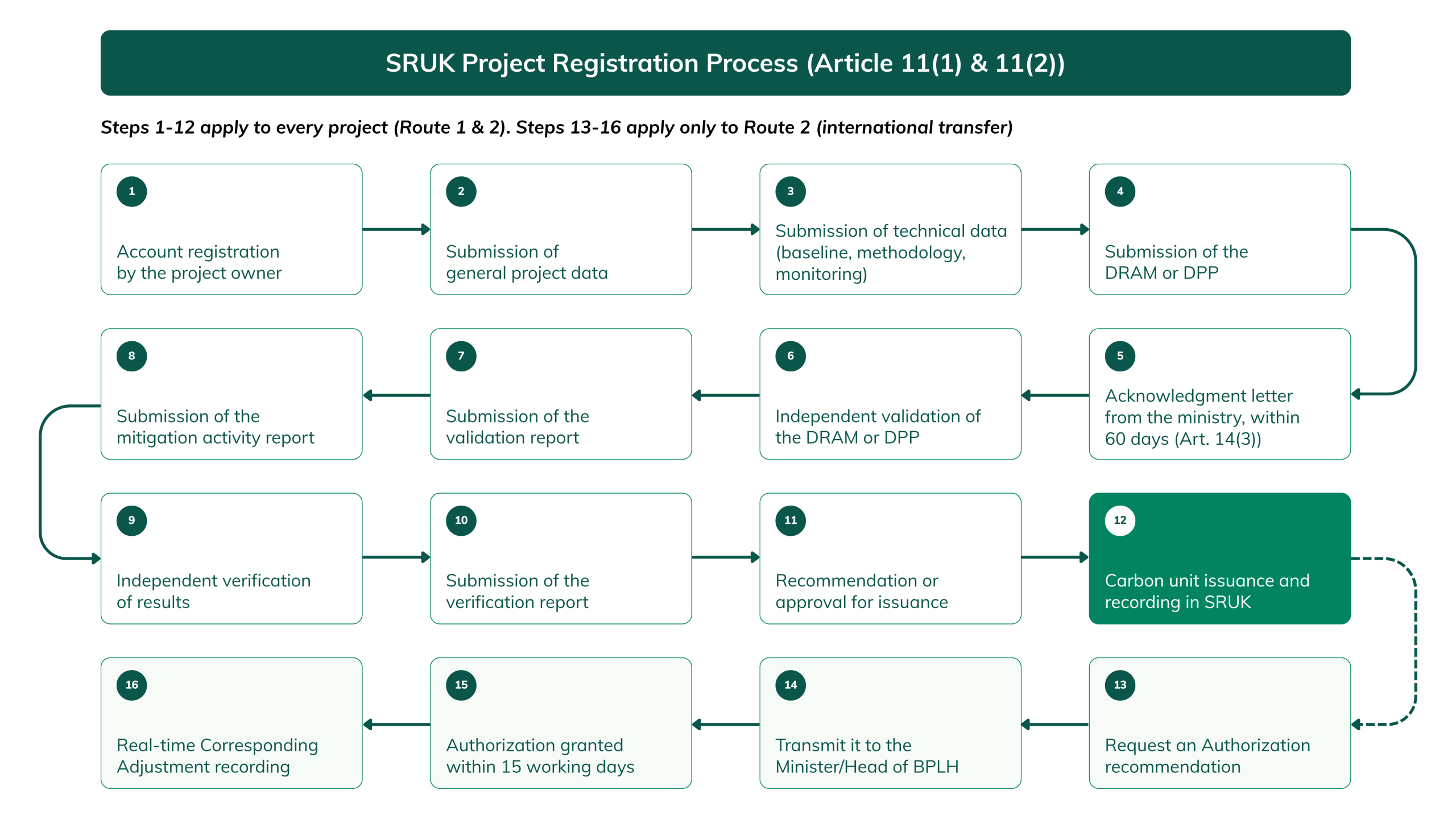
Once registered, projects proceed through validation, implementation, verification, and carbon-unit issuance before the issued units are recorded in SRUK. Companies or investors who want a walkthrough of what this stage demands can review our project development service.
Monitoring, Reporting, and Verification (MRV)
Before a single unit is issued, the emission reductions or removals a project claims must be measured, reported, and independently verified. MRV is the evidence layer that gives a carbon unit its credibility, and SRUK records the outcome of that process rather than replacing it. Perpres No. 110/2025 Article 85(1) sets the criteria for independent validation and verification bodies: they must be legal entities, employ validators and verifiers competent in the relevant sector, and be accredited either by the National Accreditation Committee (KAN) for units issued from SRUK, or by an internationally recognized accreditation body for units from an international carbon registry scheme.
Under Article 88(5), the Minister will not issue SPE-GRK units if the project owner fails to report its measurement results in SRUK. Weak MRV therefore does not just lower a unit’s value; it can block issuance outright. See what separates a credible credit in our note on what makes a high-quality carbon credit.
Carbon Unit Issuance
Once verification is complete, carbon units are issued and recorded in SRUK. Indonesia’s framework distinguishes SPE-GRK units (Sertifikat Pengurangan Emisi GRK, issued against the domestic SPEI standard) from non-SPE-GRK units (issued under international standards), and the issuer differs for each. Under Perpres No. 110/2025 Article 65(5), the Minister issues SPE-GRK units after receiving a recommendation from the relevant minister. Under Article 65(6), non-SPE-GRK units are issued by the international standard body once the required stages are complete and with the relevant minister’s approval. Article 88(4) adds that SPE-GRK units cannot be issued from leftover GHG emission allowances (Kuota Emisi GRK), which keeps compliance quotas and offset credits as separate instruments. Every unit carries one of four statuses:
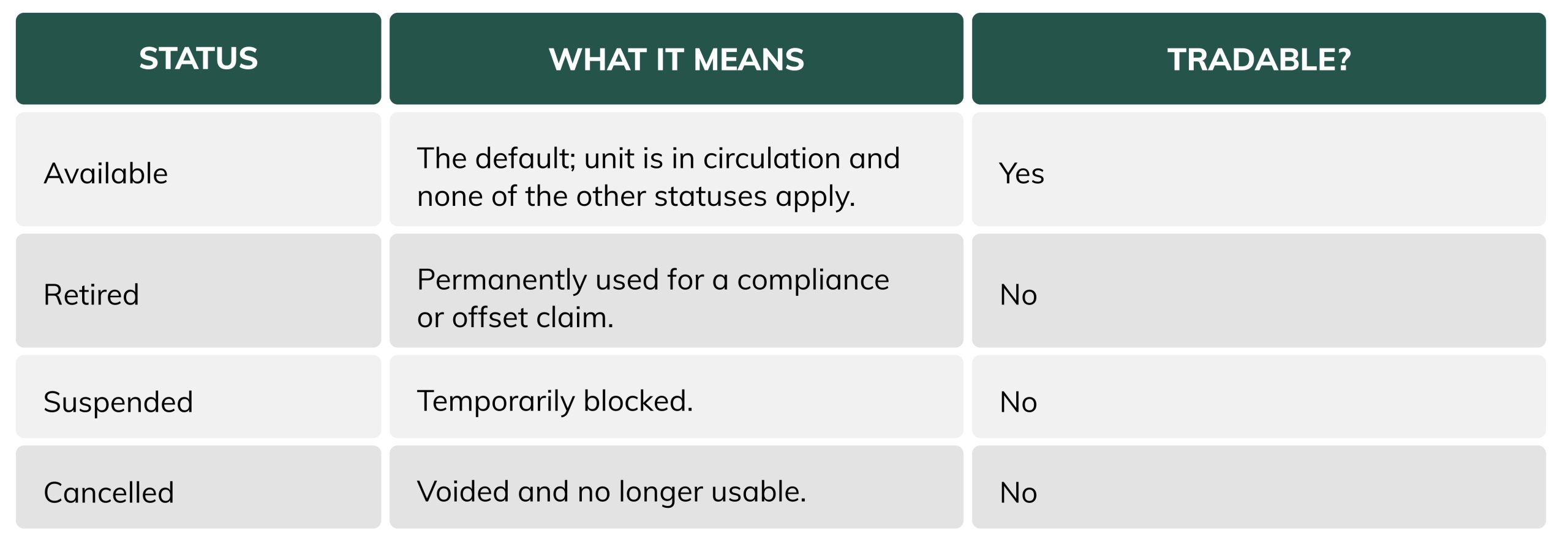
Permen LH/BPLH No. 10/2026 Article 35(1) prohibits any unit from being issued, claimed, or used more than once, and the status field is what makes that prohibition enforceable.
Ownership Recording and Transaction History
SRUK maintains a record of who owns each unit and every transfer it goes through, up to retirement. A registry number identifies the project, while each unit carries its own unique code representing one tonne of CO2 equivalent, so a specific tonne can be tracked rather than just a project total. Records also interoperate with international registries. For a buyer, this is the audit trail that confirms a credit is real, unretired, and legitimately owned by the seller.
The recording obligation is strict. Direct offset trades made off-exchange, party-to-party, must be recorded in SRUK within 2 working days of the transaction (Permen LH/BPLH No. 10/2026 Article 31(5)); a trade not recorded within that window is treated as invalid and does not count toward NDC accounting (Article 32). SRUK screens against double issuance by cross-checking geographic coordinates and the emission-reduction methodology, not just project totals. Breaching the rules carries real consequences: cancellation of issued SPE-GRK units, permanent closure of the SRUK account, an obligation to restore or buy replacement units equal to the manipulated volume, and sector-level administrative sanctions (Permen LH/BPLH No. 10/2026 Article 44).
How SRUK Supports Carbon Trading Through IDXCarbon
IDXCarbon is Indonesia’s carbon exchange, regulated by OJK; SRUK, run by the Ministry of Environment/BPLH, is the registry behind it. They are easy to confuse but do different jobs: SRUK is the registry of record for every unit, while IDXCarbon is one venue where available units change hands. For how trading itself works, see our guide on How IDXCarbon Works.
The two are built to interoperate and exchange data in real time, so a unit’s ownership and status stay current wherever it trades. IDXCarbon runs on blockchain-based trading technology, and at the forestry hub launch the government said Verra Registry, SRUK, and IDX would be connected via API using blockchain for end-to-end traceability. Under Indonesia’s capital-markets law (UU No. 4/2023, P2SK), traded units also carry legal standing as securities.
Carbon Units Before Trading
A unit must be recorded in SRUK before it can list on the exchange, and that entry stays the reference IDXCarbon checks against. Recording on the exchange adds a layer on top of the SRUK record; it does not replace it. As a result, only carbon units that are correctly recorded in SRUK can be listed on IDXCarbon.
Carbon Unit Eligibility
Under Peraturan Otoritas Jasa Keuangan (POJK) No. 10/2026 (Financial Services Authority Regulation No. 10 of 2026) on Carbon Trading through the Carbon Exchange (IDXCarbon), IDXCarbon may facilitate trading of three categories of carbon units: GHG emission quotas (Kuota Emisi GRK), domestic SPE-GRK, and non-SPE-GRK credits issued under international standards. Qualifying foreign units may also be listed, and traded units carry legal standing as securities under Indonesia’s capital-markets law. Only units marked ‘available’ can change hands, and buyers range from regulated institutions to businesses and the general public, so retail buyers are within scope.
Supporting Market Transparency
Because every issuance, transfer, and retirement is recorded and updated in real time as trades settle, buyers and regulators can follow a unit through its full history and trust that the SRUK entry is current. This integration, backed by POJK No. 10/2026, is intended to raise liquidity while reducing exposure to greenwashing and speculation.
Practical Steps During the Transition
Existing Projects Registered Under SRN PPI
Projects already registered under SRN PPI carry over and do not restart from scratch, but they must still be recorded in SRUK before new units can be issued or traded (issuance stays subject to the relevant minister’s recommendation or approval). While interoperability with international schemes is not yet live, the sector minister records eligible units in SRUK within 2 working days of the verification report, certificate, or transaction (Article 46), the interim route for Verra and Gold Standard projects. Confirm your records are actually in SRUK, and keep documentation current, since gaps are the most common reason a unit fails to reach ‘available’.
Regulatory Developments to Monitor
The interim recording system runs only until around 6 October 2026 (POJK No. 10/2026), and the SRUK–IDXCarbon integration is still being completed for real-time syncing. Sector rules are also landing unevenly: forestry is covered by Permenhut No. 6/2026, while marine, fisheries, and agriculture have no aligned rules yet, so developers there stay bound by SRUK registration for now.
Next Steps for Project Owners, Buyers, and Investors
As the market continues to mature, understanding how SRUK works is only the first step. Successfully developing, purchasing, or investing in carbon credits also requires navigating project registration, MRV, carbon-unit issuance, and registry-based due diligence.
TruCarbon supports landowners or permit holders with eligibility assessment, DRAM or DPP preparation, monitoring via TruMRV, and registration and issuance through project development; and buyers and investors with registry-based due diligence and credit-portfolio assessment. If you plan to develop a carbon project or are weighing a carbon investment in Indonesia, get in touch with TruCarbon.
Frequently Asked Questions
What is SRUK?
SRUK (Sistem Registri Unit Karbon) is Indonesia’s carbon unit registry. Perpres No. 110/2025 Article 1(20) defines it as the system for providing and managing data and information on carbon units at the level of carbon-economic-value instruments. It records the issuance, ownership, transfer, and retirement of carbon units and, per Permen LH/BPLH No. 10/2026, is intended to manage carbon-unit data, support Indonesia’s NDC target, and prevent double counting. It launched on 9 July 2026.
Who operates SRUK?
The Ministry of Environment/BPLH operates SRUK, not OJK. OJK regulates trading on the IDXCarbon exchange under POJK No. 10/2026, but the registry itself sits with the Ministry of Environment/BPLH under Permen LH/BPLH No. 10/2026.
What is Permen LH/BPLH No. 10/2026?
It is the Minister of Environment/Head of BPLH Regulation No. 10 of 2026 on the Carbon Unit Registry System, signed on 2 July 2026. It is the implementing regulation that establishes how SRUK works: registration routes, carbon-unit records, unit status, ownership, transfers, and retirement.
What is the difference between SRUK and SRN PPI?
SRN PPI records Indonesia’s climate mitigation and adaptation actions at the NDC level (Perpres No. 110/2025 Article 1(19)). SRUK records carbon units as tradable assets at the instrument level (Article 1(20)). Perpres No. 110/2025 separated these two functions, which were previously combined in one system.
Does SRUK replace SRN PPI?
Not entirely. SRUK replaces SRN PPI as the registry for tradable carbon units, while SRN PPI continues as the reporting system for national climate actions. The two run in parallel with different roles.
How do I register a carbon project in SRUK?
Register the project account, submit general and technical data, and file a DRAM or DPP document; the relevant minister issues a recognition letter, an independent body validates the DRAM/DPP, the project is implemented and independently verified, and the minister then recommends issuance, at which point units are recorded in SRUK (Permen LH/BPLH No. 10/2026 Article 11). Trades meant for international transfer add an Authorization step, granted within 15 working days, plus a Corresponding Adjustment.
How does SRUK connect to IDXCarbon?
IDXCarbon, Indonesia’s carbon exchange regulated under POJK No. 10/2026, maintains an interface integrated with SRUK. Only units with an ‘available’ status can trade, and ownership records update between the two systems in real time.
What happens to projects already registered under SRN PPI?
They remain recognized and do not need to restart the project development process from scratch, and DRAM or DPP recognition granted before Perpres No. 110/2025 carries over under the transition provisions. They do still need to register with SRUK so the project and its units are recorded there, and issuing new units remains subject to the relevant ministerial recommendation or approval.